Beyond Purdue

L2 Channels  /  the passive data diode

One way by construction, not by configuration.

A channel decides what is allowed to pass. Records leave on one path, commands enter on another, never mixed. The passive data diode makes the outgoing path one way with physics: a magnet and an optical isolator, nothing to set and nothing to switch off.

The Faraday arrow: what the diode does not have, the physics of Faraday in 1845 and Rayleigh in 1885, and the direction: data leaves, out.

The explainer

Two minutes, line by line

The arrow reads itself. Each bar becomes its sentence, and the amber shaft lights last. In English or Spanish.

Line by line

What each bar says

The head is what the diode does not have. The shaft is the physics. The direction is the point.

  1. No chip.

    The one-way part has no electronics. A splitter, a fusion splice and an optical isolator.

  2. No battery.

    Nothing inside stores energy. Nothing to charge, swap or let run flat.

  3. No power supply.

    A permanent magnet does the work. The isolator needs no power at all.

  4. No firmware to flash.

    There is no code in the path. Nothing to update, nothing to backdoor through an update.

  5. Faraday, 1845

    A magnetic field rotates polarised light in glass. The Faraday effect.

  6. Rayleigh, 1885

    The rotation keeps its sense when light comes back. Between two polarisers, that is a one-way door.

  7. BM Global

    BM Global builds it into a passive data diode for power plants and industrial sites.

  8. No password to steal.

    No login, no management port, no account. There is nothing to sign in to.

  9. No speed limit.

    The isolator does not care about bit rate. The transceivers on each side set the speed.

  10. Data leaves.

    Light travels forward, from the plant switch to the receiving switch.

  11. Out.

    Light sent backwards is blocked by the isolator. Check it yourself with a power meter.

The optical path

Three parts between two SFP ports

A 90/10 splitter, a fusion splice and an optical isolator. Ten percent of the plant light returns to the sending port, so its link stays up although nothing comes back from IT.

OT SIDEswitch, PC or server RXTXSFP Off-the-shelf SFP port IT SIDEswitch, PC or server TXRXSFP NOT IN USEdust plug fitted Off-the-shelf SFP port INPUT SPLITTER1 × 2 · 90/10 OUTPUT 10 % back to its own RX, keeps the OT link up OUTPUT 90 % FUSION SPLICE OPTICAL ISOLATOR light sent back stops here 1234 DATA FLOW, ONE WAY 1A-TXOT side TX to splitter inputLC/UPC290 %Splitter output to isolator inputfusion splice3B-RXIsolator output to IT side RXLC/UPC4A-RXSplitter 10 % back to OT side RXLC/UPC The isolator makes the path one way. The fibre on either side carries light in both directions.

Swipe sideways to see the whole path.

What it plugs into

Any SFP port, on equipment you already have

The drawing shows the two ends as boxes, but the diode only sees two SFP ports. What sits behind each port is up to you.

The diode works on light alone. It does not see the operating system, the network or the application behind the port. Nothing to install for the diode itself, no driver and no agent.

The software on each side has one rule: send, or listen, and never wait for a reply. TCP needs replies, so it does not cross on its own; UDP does. In our lab two ordinary Linux computers with standard Intel and Realtek network cards move files through the diode, and every file is checked by SHA-256 on arrival.

The plant keeps its own network, its own servers and its hardwired protection. The diode only adds a way out.

Unmanaged switch

An ordinary switch with an SFP slot at either end.

Media converter

Copper to SFP, in front of a LAN port you already have.

SFP network card

Straight into an existing server, PC or RTU. No switch needed.

Lab bench: the passive data diode in an open tray between the OTZ computer and the ITZ computer, each connected through an unmanaged switch with an SFP slot
Our lab bench, October 2026. The passive diode in an open tray, between two ordinary computers. Each computer reaches it through an unmanaged switch with an SFP slot.

Tested

942 Mbit/s, and not one frame lost

Our engineering verification on 6 November 2026: the PDD1 design between two Linux computers with 1000BASE-LX SFP optics, load raised step by step to the limit of the sender.

942.2 Mbit/ssustained receive rate
175 milliontest frames, zero lost
7 / 7files matched by SHA-256
0packets sent from the IT side
StageOffered loadMean Mbit/sPeak 5 sFrames receivedLost
S08500 Mbit/s500.0501.125,000,0000
S08A600 Mbit/s600.0601.725,000,0000
S08B700 Mbit/s700.0700.325,000,0000
S08C800 Mbit/s800.0800.725,000,0000
S08D900 Mbit/s900.2908.325,000,0000
S09Unthrottled942.2956.850,000,0000

Mean receive rate over five-second samples. Zero CRC, receive and FIFO errors in every stage. In the unthrottled stage the sender itself topped out at 942 Mbit/s, so that figure is the bench ceiling, not a diode limit. Measured frame rates, not a guaranteed file throughput. Source: BM Global verification report TR-PDD-003.003 Rev 0. The full figures are in the PDD1 datasheet.

The real module

PDD1, 100 × 80 × 10 mm

A sealed box with three 0.3 m leads coming out of its short edge. No power socket, no port to log into. The label says what it is not, and which way the data goes.

PDD1 passive data diode module with the BM Global label and its three fibre leads, A-TX, A-RX and B-RX, ending in blue LC connectors
PDD1 and its three leads. Studio image made from photographs of the unit; the label is as printed.
Close-up of the PDD1 label: no chip, no battery, no power supply, no firmware, and the line one way by construction, not by configuration
The label up close.
The three fibre leads marked A-TX, A-RX and B-RX, each ending in a blue LC/UPC connector
The leads carry the same names as the drawing: A-TX, A-RX, B-RX.

How the isolator works

A magnet, a crystal and a door that only opens one way

On 13 September 1845 Michael Faraday placed “a piece of heavy glass” between the poles of an electromagnet and saw the plane of polarised light turn.1 In 1885 Lord Rayleigh pointed out what follows: the turn keeps its sense when the light comes back, so between two polarisers the path opens one way only.2

A fibre isolator does the same with a garnet crystal, a permanent magnet and birefringent wedges. Forward, the two beams meet again at the output fibre. Backward, the rotation adds instead of cancelling, and the light is steered into the housing wall.3

Faraday discovered the effect

A magnetic field rotates polarised light in glass.

Rayleigh made the one-way arrangement

Rotation that does not reverse, between two polarisers.

The isolator makes the path one way

Glass and fibre carry light both ways. The isolator is what stops it.

Measure it yourself

Bring your own meter

  1. Leave the switches off the diode, or run it on a bench.
  2. Send light into the IT lead (B-RX) from a 1310 nm source or an SFP.
  3. Put an optical power meter on the OT side (A-TX and A-RX).
  4. Read the meter. Then send light forward, OT to IT, and read again.

The same test works on any channel product. If a vendor cannot let you run it, ask why.

If the magnet weakens

It does not fail open

The garnet runs in magnetic saturation, so a small loss of field changes nothing.4 Sintered NdFeB magnets kept below their critical temperature are estimated to lose under 1 % in 30 years.5

A large loss would make the isolator worse in both directions at once: forward light drops together with the blocking. The receive power on the IT side shows it. It does not turn silently into a two-way link.

Where it fits

L2 Channels, the gate of the data plane

In Beyond Purdue every device is sorted by what it is allowed to do. L2 Channels decide what is allowed to pass. The data plane lives on shouts: every message goes one way to a group, is repeated, and is never acknowledged. That is exactly what a diode carries.

NIST defines a one-way transfer device and names the example: “A common example is a fiber optic isolator.”6

Protection stays hardwired at L0. The diode does not replace it; it keeps the network from reaching it.

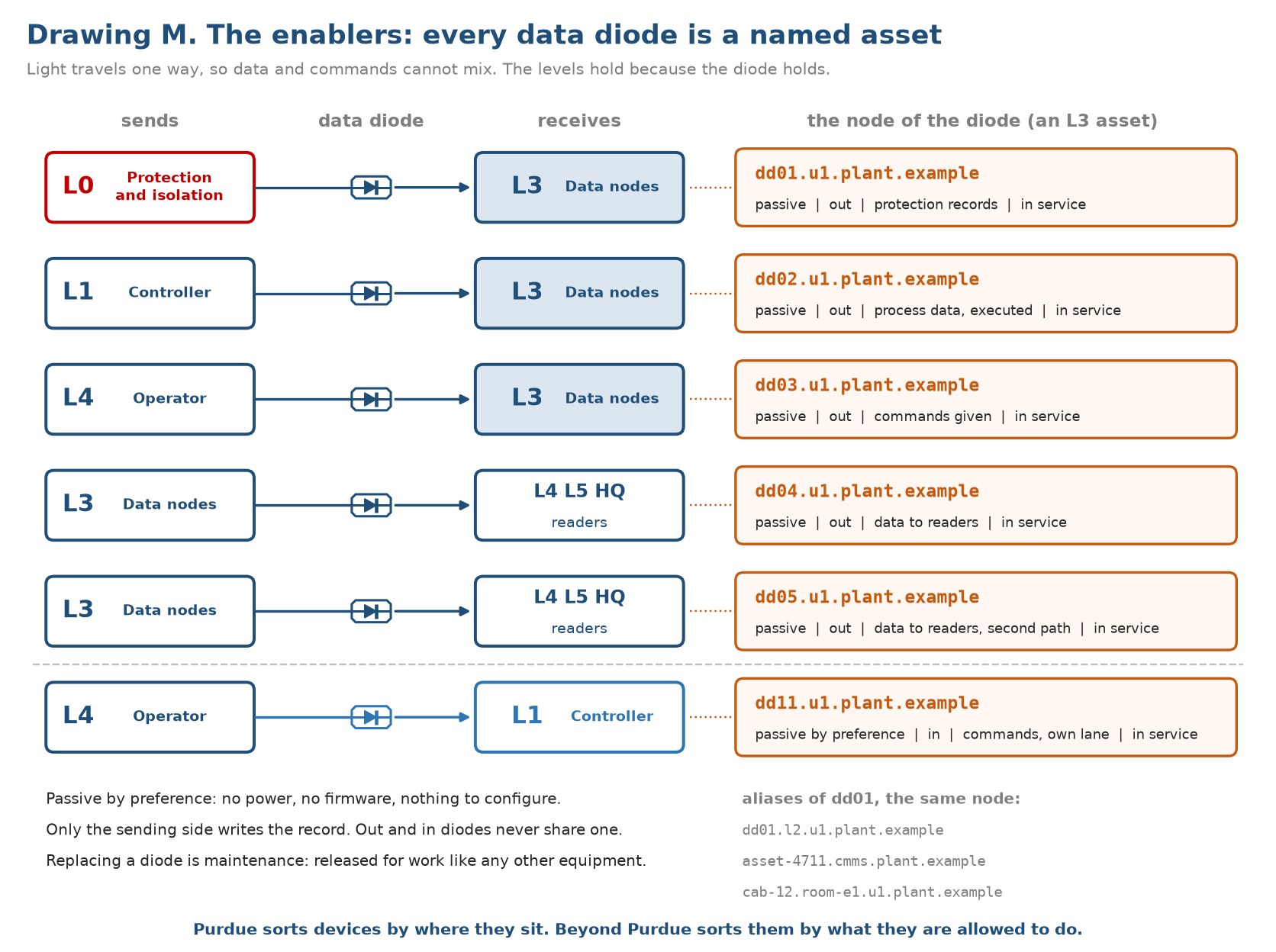
Drawing M: the enablers, every data diode is a named asset
Drawing M. Every data diode is a named L3 asset. dd04 and dd05 carry data out on two paths; commands use their own lane.

Stories from plants

Data that only needs to leave

Each story names a real system, real data and a real receiver, and says what the diode does not solve. Plant names are examples.

Coal and gas plant

Trip logs to the engineers’ desks

After every trip the engineers walk to the control room with a USB stick to collect the logs. They want them on their desk instead.

DCS engineering PC to an office listener PC

Folder to folder. Works today on Linux

Honest limit. Nothing can be re-requested: files sent while the receiver is off are lost unless the sender repeats them. A passive diode protects the network path, not the plant from an insider at the console.

Coal and gas plant

Vibration spectra to the turbine OEM

The turbine OEM asks for a VPN to the vibration monitor. The plant refuses and loses warranty arguments.

Vibration monitor to the OEM diagnostics portal

Folder to folder. Works today on Linux

Honest limit. Nothing can be re-requested: files sent while the receiver is off are lost unless the sender repeats them. A passive diode protects the network path, not the plant from an insider at the console.

Coal and gas plant

Fuel stock to ERP

Procurement orders coal on yesterday’s stock figure because the plant data never reaches ERP.

Fuel handling system to ERP and procurement

Folder to folder. Works today on Linux

Honest limit. Nothing can be re-requested: files sent while the receiver is off are lost unless the sender repeats them. A passive diode protects the network path, not the plant from an insider at the console.

Coal and gas plant

Security logs to the SIEM

The security team sees the IT network but has no view of the DCS. The logs must reach the SIEM without a path back.

DCS servers and switches to the SOC

Native UDP. Works today, no transfer software

Honest limit. Plain UDP has no delivery confirmation; the receiver must be listening when data is sent. A passive diode protects the network path, not the plant from an insider at the console.

Coal and gas plant

Emissions without retyping

The emissions report is retyped from the CEMS screen every month, and auditors ask how they can trust it.

CEMS analyser PC to environmental reporting

Folder to folder. Works today on Linux

Honest limit. Nothing can be re-requested: files sent while the receiver is off are lost unless the sender repeats them. A passive diode protects the network path, not the plant from an insider at the console.

Coal and gas plant

A backup ransomware cannot reach

If ransomware hits the office, the backup of the ES680 engineering station must sit where the attack cannot reach or encrypt it.

ES680 engineering station to an offsite vault

Folder to folder. Works today on Linux

Honest limit. Nothing can be re-requested: files sent while the receiver is off are lost unless the sender repeats them. A passive diode protects the network path, not the plant from an insider at the console.

Coal and gas plant

Fire and gas logs for the audit

The safety office needs the fire and gas event log for the audit, without a link to the safety system.

Fire and gas system to the safety office

Folder to folder. Works today on Linux

Honest limit. Nothing can be re-requested: files sent while the receiver is off are lost unless the sender repeats them. A passive diode protects the network path, not the plant from an insider at the console.

Transmission substation

Fault records from every relay

After a fault, the protection engineers want the records from every relay without logging in remotely.

Protection relays to the protection department

Folder to folder. Works today on Linux

Honest limit. Nothing can be re-requested: files sent while the receiver is off are lost unless the sender repeats them. Teleprotection and SCADA control still need their own two-way links. The diode carries data that only needs to leave.

Dam and reservoir

Reservoir level for the people downstream

Residents downstream want to see the level during a storm. The valves and gates are controlled from a small local panel.

Level sensor to a public flood website

Folder to folder. Works today on Linux

Honest limit. Nothing can be re-requested: files sent while the receiver is off are lost unless the sender repeats them. The diode stops remote control through the network. It does not replace strong local passwords or physical security.

Real incidents

What happened, and what a diode would and would not change

Public reports only. A diode is one tool. Each angle states its limit.

  1. Wind, February 2022

    The Viasat KA-SAT attack cut Enercon’s remote monitoring and control of 5,800 turbines. They kept generating. The Stack

    Separate monitoring from control. A diode does not stop an attack on a satellite modem.

  2. Dam, April 2025

    A valve at a Norwegian dam was opened remotely for about four hours through a web panel. AP News

    Data goes out without a web panel exposed. Local passwords still matter.

  3. Retail, 2013

    The Target breach began with credentials stolen from its refrigeration and HVAC contractor. NPR

    The vendor gets data, not a login.

  4. Building, 2017

    Casino data was taken out through an internet-connected fish tank. The Washington Post

    Building sensors report out one way and cannot become a way in.

  5. Solar, May 2025

    Undocumented communication devices were found in some Chinese inverters and batteries. Reuters

    The diode protects the plant network path. It cannot stop a radio inside the device.

The Nights

She tells. The king never answers back.

Scheherazade stayed alive by telling a story every night and stopping before the end. The data plane works the same way.

  • She tells, never asks. Every message goes one way and is never acknowledged.
  • She tells again. Repeat instead of acknowledge, so nothing is lost.
  • One story a night. Every node sends its own 24-hour summary.
  • At least two copies. Both listen to the same shouts. Lose one, and the story survives.
  • The dhow carries cargo out. The isolator lets light pass one way only, so data and commands cannot mix.
  • The king’s word is recorded. Every command leaves two marks: given and executed.
  • People are protected while the story is told. “Released for work” is a shout too. The lock holds the machine still.
  • Dawn came, and the story stopped. Nothing came back.

Sources

References

Faraday discovered the effect. Rayleigh made the one-way arrangement.

  1. M. Faraday, Diary, 13 September 1845, paragraph 7504. http://faradaysdiary.com/ws3/faraday.pdf. Experimental Researches in Electricity, Nineteenth Series, Phil. Trans. R. Soc. 136, 1–20 (1846). https://archive.org/details/philtrans00754832
  2. Lord Rayleigh, Phil. Trans. R. Soc. 176, 343 (1885). https://www.nature.com/articles/064577e0 and https://ar5iv.labs.arxiv.org/html/2104.06530
  3. Thorlabs, fibre optic isolators. https://www.thorlabs.com/newgrouppage9.cfm?objectgroup_id=9693. RP Photonics, Faraday isolators. https://www.rp-photonics.com/faraday_isolators.html
  4. Magneto-optical garnets in saturation. https://www.sciopen.com/local/article_pdf/10.26599/JAC.2023.9220742.pdf. Technical description: https://patents.google.com/patent/EP0752713B1/en
  5. M. Haavisto et al., Magnetic Behavior of Sintered NdFeB Magnets on a Long-Term Timescale, 2014. https://onlinelibrary.wiley.com/doi/10.1155/2014/760584. Neorem, time-dependent demagnetization of sintered NdFeB. https://neorem.fi/wp-content/uploads/2023/01/Studies-on-the-Time-Dependent-Demagnetization-of-Sintered-NdFeB-Permanent-Magnets.pdf
  6. NIST CSRC Glossary, one-way transfer device. https://csrc.nist.gov/glossary/term/one_way_transfer_device

Text licensed under CC BY 4.0. Attribution: Petr Roupec, beyondpurdue.com