Beyond Purdue / Operations
The Hidden Limits of Automation: When the Numbers Lie
Everyone in automation trusts the numbers. Until the numbers stop making sense.
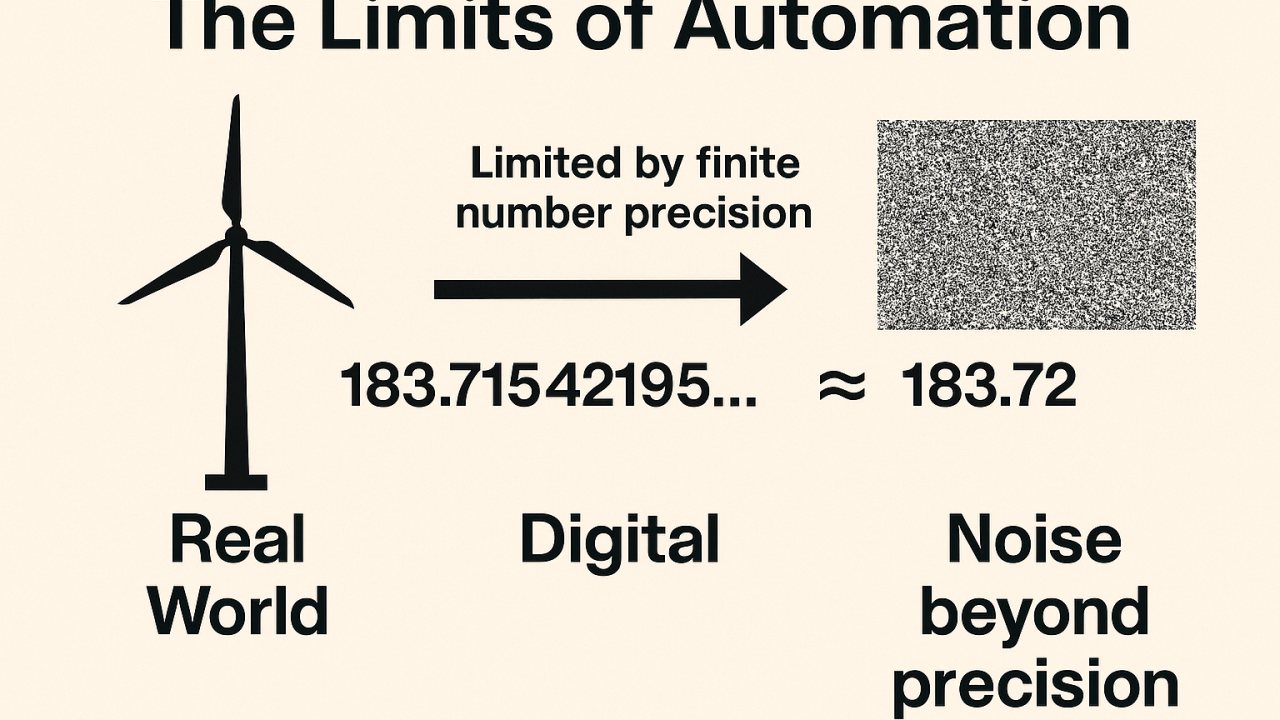
Everyone in automation trusts the numbers. Until the numbers stop making sense.
Let’s take a real example: an energy counter reading 7,724,739. On the surface, it seems precise. You might even see decimals like 0.5 MWh in some OPC displays. But here’s the hard truth:
At this scale, those decimals are fiction.
Precision Ends Where Digital Noise Begins
Industrial control systems, like Siemens S7 or TXP, typically use 32-bit floating-point numbers — a format that cannot maintain the same level of precision across its entire range.
Once the number exceeds a few million, it loses the ability to represent small changes. For values around 7 million, the resolution drops to ±2. Meaning: if the value changes by 1, the system won’t even notice. It’s invisible. Just noise.
You can still see the decimal — but it’s fake precision. The system rounded it, guessed it, or copied it from another place that has no real physical meaning. This isn't a bug. It's how digital math works.
A Grain of Truth: Explaining It Simply
Imagine you’re counting grains of rice.
At first, it’s easy: 1, 2, 3. Every grain matters. Now imagine someone dumps 7 million grains in front of you and asks: “Did we just add one more grain?”
You’d never know. That’s what digital systems do at high numbers — the details disappear.
Recommended by LinkedIn
Why It Matters for Automation, Monitoring, and Trust
This limitation has real-world impact:
- Billing systems rely on counters that may be fuzzier than expected
- OPC clients may show decimals that look precise but are mathematically meaningless
- Engineers may chase “errors” that are nothing more than quantization artifacts
If you don’t understand this, you end up fixing problems that don’t exist — or worse, missing ones that do.
It’s also a reminder of something bigger: automation isn’t magic. It’s built on layers of assumptions, approximations, and digital shortcuts.
At some point, all of us — vendors, engineers, operators — need to stop and ask:
Are we seeing real data, or just the illusion of it?
This is why in our Beyond Purdue series, we emphasize meaning, structure, and trust in data over buzzwords like “digital twin” or “smart dashboards.”
Because once you lose physical grounding, all you're doing is notarizing noise.
Want to see more stories like this? Follow the Beyond Purdue newsletter or visit www.bohemiamarket.com for how we build trust into data at the edge — where it actually matters.