Beyond Purdue No. 067 / AI, Video
I asked for to fill missing miles ....
I did not fill in a single missing-mile claim form. I opened the airline's web page, made sure I was logged in, and asked my AI assistant to handle it.
I did not fill in a single missing-mile claim form. I opened the airline's web page, made sure I was logged in, and asked my AI assistant to handle it.
The assistant found the relevant flight information in my emails, compared it with my loyalty account, filled in the missing-mile claims and submitted them through the website. Nine claims were submitted while I was able to concentrate on works what matters.
For the form-filling itself, I did not have to touch anything. I did not copy ticket numbers, type flight details into the airline's forms or move information manually between windows.
The data - emails, documents, boarding passes
The evidence was scattered across emails, tickets, revised bookings and account records. Once access was available, the assistant handled the searching, extraction, comparison and assembly of that data.
I did not manually prepare a spreadsheet or design a database before asking the question. I did not commission a travel application, specify its screens or start a software-development project.
I gave instructions, authorized the actions and corrected a few ambiguous travel details. But gathering the data, putting it together and producing the outputs were largely automatic.
This is the part I want to emphasize: the automation did not begin only after somebody had already organized everything neatly. It helped turn the scattered information into something usable in the first place.
One dataset, many useful results - The Experiment
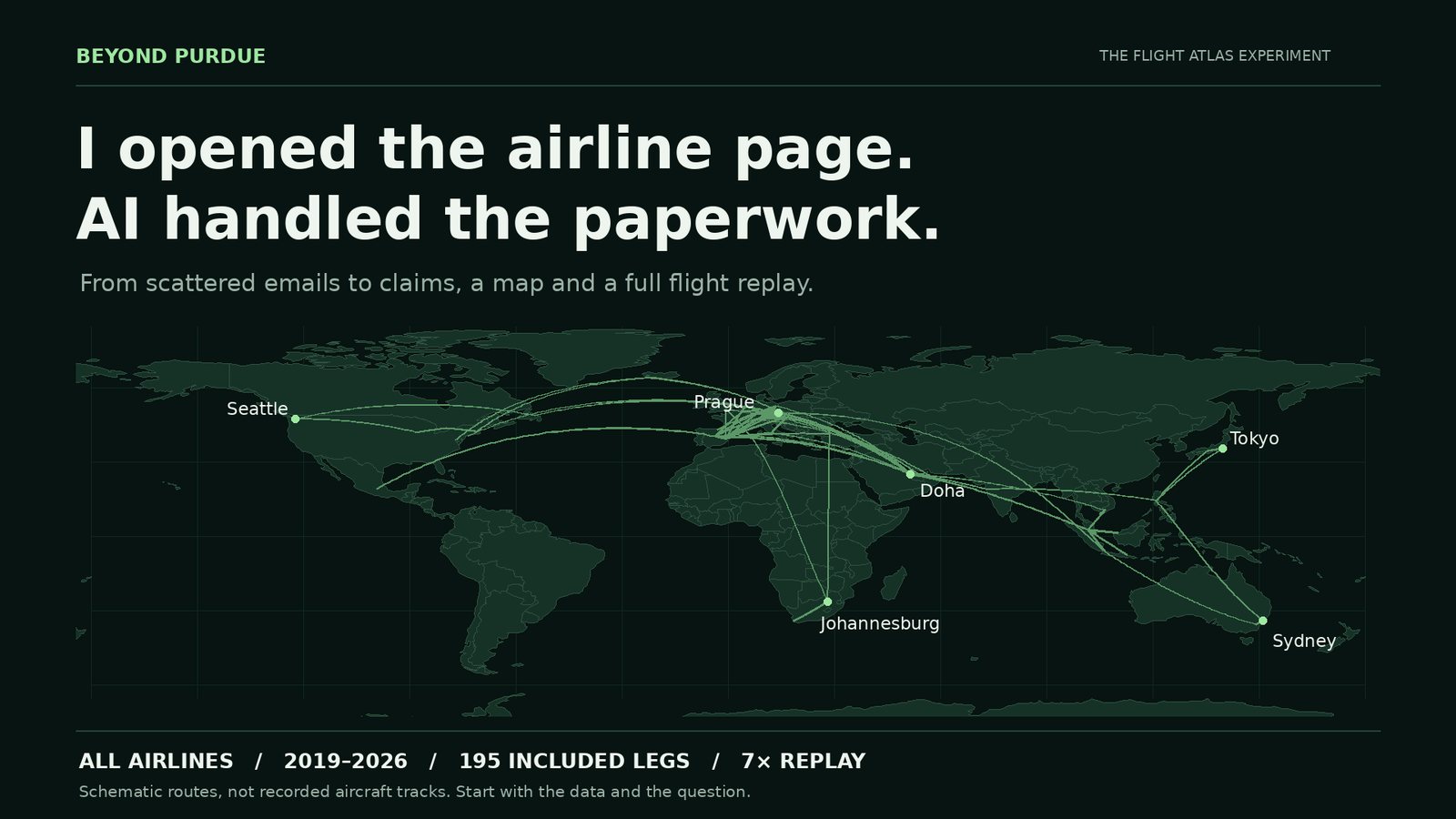
As I was bored on another intercontinental flight I asked my AI assistant - Can you create interactive map, with selectable years and adjustable playback? The map became a video. The history expanded across airlines and into older travel, including government delegations whose routes were not fully described by ordinary airline tickets.
At the current snapshot, there are 252 source records and 195 included flight legs covering 2019–2026. Those are not 195 independently verified boarding events. They are included records supported by named bookings, programme documents and explicit participant corrections, with uncertain and excluded material retained separately.
The useful result was not just a picture. It was a reusable body of data, with evidence and decisions behind it, that could support another question without starting again.
Do we still need to develop another system?
My conclusion is direct: we no longer need to develop a dedicated system for every information task. We have data; AI can gather it, assemble it, perform authorized actions and present the result in the form we need and like ...
The old sequence was often: define the application, design the database, build the integration, develop the interface and finally answer the question. In this experiment, I started with the question.
Recommended by LinkedIn
The assistant worked with the data and systems already available. It generated the processing and presentation code needed for the task, rather than requiring me to develop and maintain a separate product first.
A table when I need a table. A map when I need to understand the journeys. A video when I want to share the story. An action in an existing website when I want to claim the missing miles.
That is what I mean when I say there is no need to develop another system: the question does not automatically have to become a permanent new application. The data, the intent and the permissions can come first, with the workflow and presentation assembled around them.
Why this belongs in Beyond Purdue
On the same trip customer asked us for communication with ION 800 meters which of course talks in proprietary protocol .... well we listen and present data via NodeRed interface - can you imagine to create this Dashboard using standard HMI tools such as WIN CC, PCS7, Citect, Reliance .... you name it. This dashboard has been created within five seconds by our in house AI
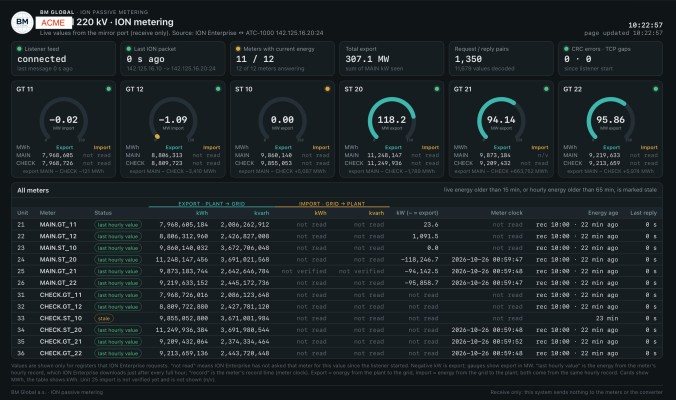
HMI interface created on demand
The current flight map is schematic, not a reconstruction of recorded aircraft tracks. Historical-track matching is the next experiment, with access, cost and licensing checked before buying data.
The full all-airlines replay is the main travel video, not just a short editorial summary. The underlying evidence, datasets, map source and all video versions are preserved in a private archive so the work can continue.
I began by asking for missing miles. I opened the airline's page, and the assistant did the form-filling; the same accessible data then became a register, a map, a replay and a project archive.
For me, that is the point: do not start by developing another system. Start with the data and the question, then let AI help gather, act and present.
Which of your workflows really needs a new application, and which simply needs access to the data and permission to do the work?