Beyond Purdue No. 058 / Architecture, AI
COBOL? Close to Source. Meaning Tags. Why Everyone Should Be Able to Work With Plant Data — Without Programming
Continuing from #057: Your AI Analytics Platform Is Built on a Chain of Broken Rulers
Continuing from #057: Your AI Analytics Platform Is Built on a Chain of Broken Rulers
"Data should be processed as close to the source as possible."
That sentence is not new. It is one of the oldest principles in computing. And yet — as previous article No. 057 demonstrated with a GUM-compliant error budget — the entire industrial AI industry is built on the exact opposite: collect raw measurements at the field, move them upward through five layers of degradation, and ask a compressed, quantized model to find subtle signals in what remains. The result: ±6.4% expanded uncertainty before the AI produces a single output. Any probability smaller than that is statistically indistinguishable from noise.
The solution is not a better model. The solution is architecture. And to think clearly about a new architecture, this article connects two ideas that seem completely unrelated: a 67-year-old programming language, and a principle called Meaning Tags.
Taleb's Warning: You Cannot Create Information Where There Is None
In The Black Swan, Nassim Taleb states it plainly: "There is no reliable way to compute small probabilities." He demonstrates — using decades of economic data — that a single rare event can represent 90% of the kurtosis of an entire dataset. Miss that one event in your data pipeline, and you have missed the whole story. Standard deviation, variance, least-square deviation — all of it becomes, in his word, bogus, if the rare event has been filtered out before the calculation.
"You cannot create information where there is none." — Nassim Nicholas Taleb, The Black Swan
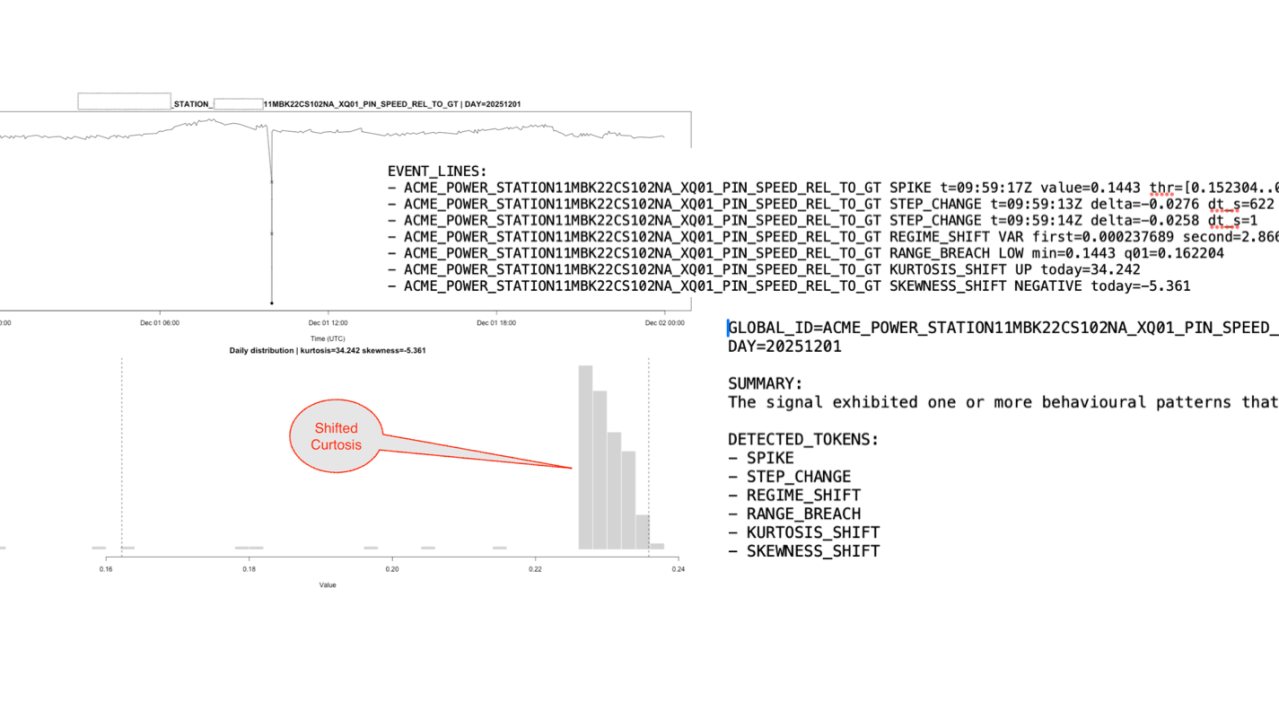
This is precisely what happens in an industrial historian with 10:1 to 100:1 compression. The swinging door algorithm discards values that do not move enough. It is designed to discard them:
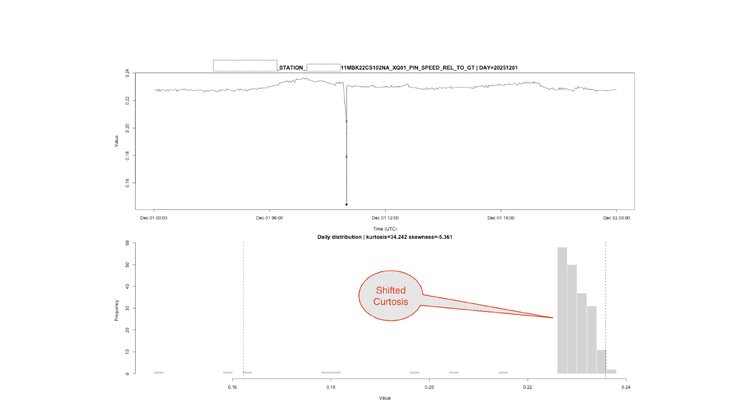
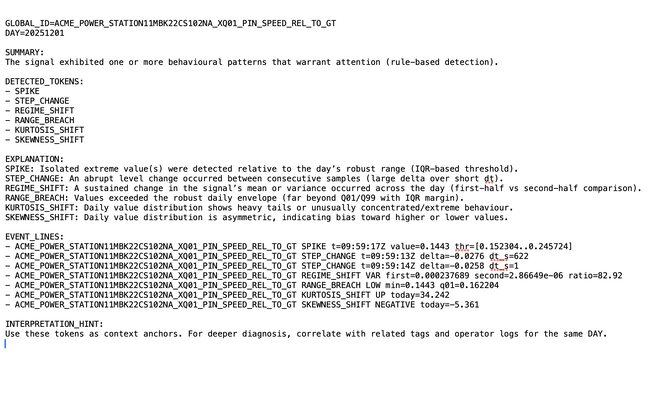
- A SPIKE event lasting 4 seconds,
- a STEP_CHANGE of -0.028 in bearing speed,
- a REGIME_SHIFT where variance drops by
- a factor of 83
—> these are the rare events that carry almost all of the diagnostic information. They are exactly what compression removes. No AI model, no matter how sophisticated, can recover them from averaged historian data. Taleb's principle is not abstract philosophy here. It is an engineering constraint
COBOL: The Manager Who Could Program
In 1959, Grace Hopper created COBOL — Common Business-Oriented Language. The design goal, stated explicitly by its architects, was that programming should take place 'basically in English' — readable and verifiable by the person who owns the business problem, not just by the programmer implementing it.
COBOL still processes an estimated $3 trillion in daily financial transactions worldwide. Approximately 850 billion lines of COBOL remain in active use. 92% of organizations running COBOL describe their COBOL workloads as critical to their operations. Not because it is technically superior — but because it embedded domain knowledge directly into the execution layer.
A payroll clerk could read a COBOL routine and say: 'That is wrong — overtime is not calculated that way.' No translation layer. No vendor explanation required.
COBOL's real innovation: the person closest to the problem can read, verify, and own the logic that acts on it. That principle has never been solved better in 67 years.
Today, with GnuCOBOL — a free, open-source COBOL compiler that runs on Linux, Windows, and macOS — anyone can write, compile, and run COBOL programs without a mainframe, without a vendor licence, and without a data engineering team. It translates COBOL into standard C and compiles natively on any platform. This matters for what comes next.
What We Lost on the Way Up the Stack
Today in industrial control systems, the data chain looks like this: a field engineer calibrates a sensor. A controls engineer configures the ADC scaling in the DCS. A SCADA engineer sets the historian deadband. A data scientist trains an AI model on compressed historian output. A vendor dashboard presents a probability. A plant manager makes a maintenance decision.
At every step, the person closest to the physical reality hands off to someone further from it. Domain knowledge — what the measurement means, what a normal signal looks like, what a dangerous transient looks like — is stripped away at each layer.
By the time a decision is made, the decision-maker has no idea what was discarded between the sensor and the screen.
This is not a technology problem. It is an epistemological problem: systems that are very good at moving numbers upward and very bad at moving meaning upward with them.
The Answer: Meaning Tags
Meaning Tags are the practical implementation of 'process data as close to the source as possible.' Instead of moving raw numbers upward and hoping something survives compression and quantization, Meaning Tags convert raw signal behaviour into deterministic, human-readable event tokens — at the source, before any compression occurs, from full-resolution uncompressed time-domain data.
A Meaning Tag is not a probability. It is not a model output. It is a named, timestamped, physically interpretable statement about what a signal did:
- FAST_RISE,
- FAST_DROP,
- SPIKE,
- STEP_CHANGE,
- REGIME_SHIFT,
- LONG_HOLD,
- KURTOSIS_SHIFT,
- SKEWNESS_SHIFT, R
- ANGE_BREACH.
Each token is the result of a defined, auditable calculation — not an inference. FAST_RISE means the signal rose faster than a defined threshold. Full stop.
A Real Example — Anonymised Plant Signal, December 2025
From a combined-cycle power plant signal analysis, one bearing-related tag produced this output on a single operating day — generated directly from raw DCS data, before any historian compression:
PLANT_EU__GAS_TURBINE_A__BEARING_SPEED_REL DAY=20251201 | STATUS=ALERT | EVENTS=5 EVENT: LONG_HOLD start=05:34Z end=08:54Z duration=3.34h EVENT: FAST_RISE start=06:51Z end=09:28Z duration=2.61h delta=+0.0177 EVENT: FAST_DROP start=09:56Z end=10:59Z duration=1.06h delta=-0.0067 EVENT: KURTOSIS_SHIFT UP today=6.456 (distribution tail weight increased) EVENT: SKEWNESS_SHIFT POSITIVE today=1.711 METRICS: N=97 | rate/hour=4.06 | kurtosis=6.456 | skewness=1.711 value_min=1.0022 | value_max=1.0492
A senior plant engineer reads this without a dashboard, without a vendor, without a model explanation. The signal held for 3.34 hours. It rose fast. It dropped fast. Its kurtosis shifted — the tail weight of its distribution increased, which is Taleb's rare-event signature in mathematical form. This is a fact. Not a probability. Not a confidence interval.
Kurtosis is not an abstract statistic. It tells you how much of the story is concentrated in rare, extreme moments. A kurtosis shift UP means: today, this signal's behaviour was dominated by tail events. That is what you need to know. And it can only be seen in raw, uncompressed data.
Whats next
On the weekend we will further develop an idea and discuss following:
The Five-Layer Architecture: From Raw Data to Plant Knowledge
Meaning Tags are the foundation of a layered architecture that solves the problem #057 identified — not by improving the AI model, but by changing what the AI model receives ....
COBOL as a Secure ICS Data Transfer Tool
The COBOL program IS the data contract.
- A controls engineer can read it.
- A cybersecurity auditor can audit it.
- A plant manager can approve it.
This is not a metaphor — it is a literal implementation of the COBOL philosophy applied to ICS secure data transfer ......
Everyone Should Be Able to Work With Data — Without Programming
Meaning Tags are the COBOL of industrial process data: a language designed so that the person who owns the problem can read and verify the answer — without needing a programmer to translate it .....
Beyond Purdue - Is about what data means.
The Purdue Model defined where data lives in an industrial architecture. Beyond Purdue is about what data means — and who is responsible for preserving that meaning as it moves upward through the system.
COBOL is 67 years old and still running. Not because it is the best language technically — but because it gave the domain expert the ability to own the logic. Meaning Tags do the same for industrial process data. They give the plant engineer a language — readable, deterministic, auditable — that travels with the signal from the field to the LLM interface without losing its meaning at any layer.
Taleb told us: you cannot create information where there is none. The corollary: if you preserve the information at the source, you do not need to create it later. And if you express it in a language the domain expert can read, you do not need a vendor to interpret it for you.
Do you like it? Drop me a message ...