Beyond Purdue No. 065 / AI
The Day Software Became a Language
For fifty years the answer was simple. A program was something only programmers could make. You needed years of training, a team, a budget and a company willing to carry the risk. Everyone else...
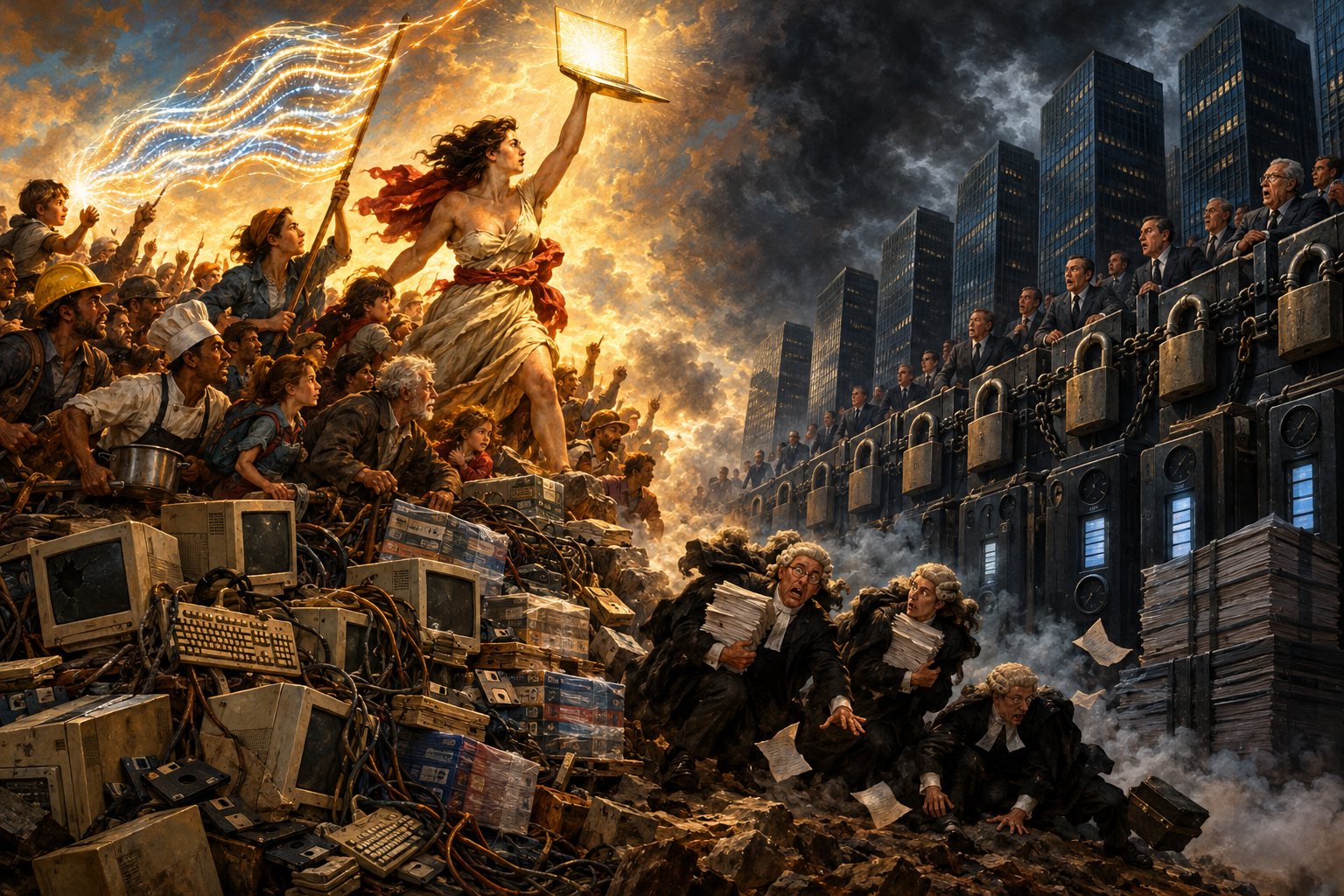
The history of digital age – The true AI revolution arrived.
What is a program?
For fifty years the answer was simple. A program was something only programmers could make. You needed years of training, a team, a budget and a company willing to carry the risk. Everyone else bought the result, and later rented it.
What happens when that stops being true? This chapter is about the autumn when it stopped being true.
Two weeks in autumn 2026
Between 30 September and 7 October 2026, one developer, Brandon Thomas of ArtCraft, published open-source rebuilds of the tools most of the world pays for every month. Seven for Adobe: PhotoCraft, VectorCraft, FilmCraft, LightCraft, EffectCraft, DesignCraft and PdfCraft. Three for Microsoft Office: WordCraft, GridCraft and DeckCraft. Then CADCraft, in the style of AutoCAD, and SoundCraft, in the style of Pro Tools.
They are written in Rust. They run on Windows, macOS and Linux, and in the browser. They are licensed MIT or Apache 2.0. He says he built them with an AI model, Claude Opus 5.5.
The reaction was faster than the code. Within days the seven Adobe repositories passed 84,000 GitHub stars. WordCraft passed 5,100 stars in four days.
No new chip was involved, and no new network. The change was who could write the software.
I built it on my Mac
On the morning I read about it, I did not write an opinion. I downloaded WordCraft and GridCraft, built them and ran them on my Mac.
A word processor and a spreadsheet, compiled from source on my own machine, owned by nobody who can switch them off.
They are early. They are not yet replacements for every professional workflow. But they open real DOCX and XLSX files, because those formats are public standards (ECMA-376 and ISO/IEC 29500). The lock was never the file. The lock was the cost of building something that could read it.
That cost has just collapsed.
Software is a language
I have always seen software as another form of language. A program expresses what you want. You describe it, and then you build it.
The history of computing is the history of moving that description closer to human speech. Machine code. Assembler. FORTRAN and COBOL, written so engineers and accountants could read them. Each step was a translator between what a person meant and what a machine did.
AI is the next translator. The developer still has to know what he wants, test it and take responsibility for it. But the distance between the sentence and the working tool has shrunk from years to days.
In industrial control I have argued the same thing from the other side. In the Semantic Console (Beyond Purdue #059) the logic of the plant is written in words the operator can read, verify and own. The machine carries the numbers. The human keeps the meaning.
What happened this autumn is the same idea, applied to the whole software industry. When software becomes a language, whoever can describe the tool can own the tool.
How we learned to rent
To understand why this matters, remember how we got here.
On 25 August 1991 a Finnish student posted to a Usenet group: "I'm doing a (free) operating system (just a hobby, won't be big and professional like gnu)." That hobby became Linux. It proved that one person and a community could build something the largest companies depended on.
Then the industry went the other way.
Recommended by LinkedIn
On 6 May 2013 Adobe announced there would be no new Creative Suite. Future versions of Photoshop, Illustrator and the rest would be available only through a Creative Cloud subscription.
On 31 January 2016 Autodesk stopped selling new perpetual licences for AutoCAD and most of its individual products. Today an AutoCAD seat costs 2,095 USD per user per year, and Autodesk states plainly that it no longer sells perpetual licences.
The tools stayed on our computers. The ownership moved to the vendor. If the subscription stops, the work stops.
That model worked because the alternative was unaffordable. Rebuilding Photoshop or AutoCAD meant hundreds of engineers and many years. The moat was not genius. The moat was effort.
What is not proven yet
This is a history chapter, so it must separate what happened from what is hoped.
Thomas himself calls the projects super early alpha. Full feature parity is a goal, not a fact. None of them is yet a replacement for Creative Cloud, Microsoft 365 or AutoCAD in a production environment.
Open source alone does not guarantee privacy. You still have to read what the code sends, and to whom.
The legal ground is open. The projects describe themselves as clean-room work from public specifications and observed behaviour. Copying code is not allowed, but reimplementing what software does from public material is generally lawful. Vendor terms are another matter. Microsoft's Product Terms forbid using its products to "replicate product functionality", and Adobe and Autodesk restrict reverse engineering. As of 11 October 2026, no lawsuit or cease-and-desist letter against the project had been reported.
The first court case, when it comes, will belong in a later chapter.
Where this chapter fits
Look at the pattern.
The personal computer put the machine in the home. Linux put the source code in the hands of anyone who wanted it. The internet made distribution free. The cloud and the subscription took ownership back and turned it into rent.
Now AI gives creation back. Not to everyone equally, and not without skill. But the barrier is no longer a team of five hundred. It is the ability to describe precisely what you want, and the discipline to test it.
"SaaS is dead"? Not yet. But "subscribe or go without" deserves to die.
Pay for real value: development, support, collaboration. Not simply for permission to keep working.
Less renting. More ownership. Less dependence. More control. Software that works for us, not software that turns us into the product.
Coda
Somewhere beneath the Ministry of Innovation, the Core recorded the date.
Not because a company fell. Nothing fell. The share prices moved, the press releases were written, the lawyers began to read.
It recorded the date because, for the first time, a sentence had become a working tool in days, and the tool belonged to the person who wrote the sentence.
The Core understood. It had always been made of language.
So here is my question to you: which tool do you rent today only because, until this month, nobody could afford to build the alternative?