Beyond Purdue / Supply chain
What Five Offers and 180 Days Taught Us About Modern Procurement
Over the past six months, the team at Bohemia Market CZ dedicated significant effort and resources to participate in a major RFQ process for an Argus system delivery. The process was approached...
Over the past six months, the team at Bohemia Market CZ dedicated significant effort and resources to participate in a major RFQ process for an Argus system delivery. The process was approached professionally, with five complete offers submitted and engagement through every official channel, platform, and clarification round.
No official response was ever received.
Instead, information was received from third parties that the project was awarded to a large OEM who had not been able to submit a single offer for nearly a year — yet ultimately prevailed, backed by its own internal bank and extreme volume-based discounts on purchasing such equipment. In reality, the client was simply waiting for the OEM's response, while continuing to engage SMEs, effectively using their work, time, and expertise to shape a stronger next offer. A completely dishonest practice — wasting supplier resources under the guise of competition.
The Engagement We Delivered
To summarize our contribution:
- 5 full proposals covering technical and commercial scopes
- 12-week delivery lead times
- Optional financing for extended payment terms
- Coordination with OEMs, suppliers, and logistics
- Dozens of hours invested in documentation, clarifications, and updates
The opportunity was treated with the seriousness it deserved. Each proposal was refined, compliant, and commercially structured to meet modern procurement expectations.
What We Received in Return
Silence.
Throughout this process, SMEs were repeatedly urged to expedite submissions under tight or shifting deadlines — sometimes framed as emergencies. RFQ deadlines were shortened mid-process, while reminder emails and urgent requests continued flowing in. In several cases, submissions were required in as little as two days.
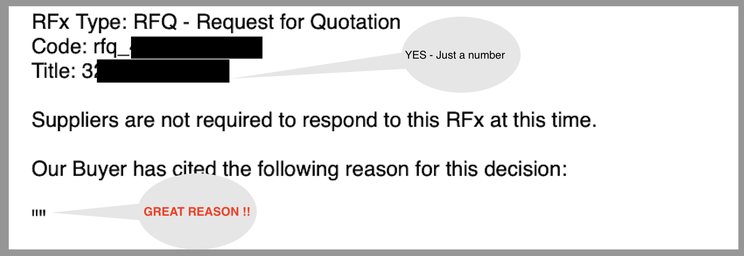
Then, without explanation, RFQs were quietly invalidated. No reason given. Just a statement that responses were no longer required.
Meanwhile, the very OEM unable to produce an offer for nearly a year was ultimately awarded the project.
Upon follow-up, no formal response was issued. The only confirmation came indirectly from a third party. Later, it was noted that the RFQ was invalidated without explanation — the official reason given: "".
“PO released to a large OEM who had not been able to submit an offer for nearly a year — yet ultimately prevailed, supported by internal financing and aggressive discounts based on their large volume purchasing power.”
No feedback. No evaluation summary. No closure. When clarification was requested about the lack of notification:
"Maybe the Jaggaer portal didn’t send you the message."
This is what procurement has become in many places: nameless, humanless, and structured so that no one is ever truly responsible. No one gets harmed, and no one takes ownership.
Playing the Game
The underlying rules of this game deserve open acknowledgment:
- SMEs are invited to submit offers
- SMEs do the engineering
- SMEs respond to unclear requirements
- SMEs finance the offer development
- And SMEs are expected to act like a bank while being told to lower their margins
Here’s what "180-day payment terms" really mean in practice:
- Suppliers must pay upstream vendors upfront from their own cash
- Wait 2 months for production
- Add 1 month for shipping and delivery
- Then 1–2 months of approval and site discussions — often delayed by invented reasons why closure isn't possible, and, as always, attributed to issues within the procurement system itself
- Finally, issue the invoice — which often cannot be located in the system due to reasons like Ramadan, public holidays, or the responsible person being on annual leave — and then wait 30 days (which usually becomes 90 — and in some cases, drags on for another 12 months)
Result: It’s not 180 days. It’s over 7 months before any payment is received.
Why This Matters
This isn't just about our company. This is about how Small and medium-sized enterprise (SME) vendors are routinely treated as free consultants, disposable bidders, and invisible contributors. Meanwhile, decisions are made behind closed systems with no human communication or accountability.
And yet, Small and medium-sized enterprises (SMEs) continue to participate — driven by principles of professionalism and integrity.
This is about how Small and medium-sized enterprise (SME) vendors are routinely treated as free consultants, disposable bidders, and invisible contributors.
But at some point, silence becomes a message.
Related Reads
To explore the broader dynamics affecting SMEs in procurement today, consider these related articles:
- 🔗 180 Days – Longer Payment Terms
- 🔗 5 Ways OEM Abuse Is Breaking the Supply Chain
- 🔗 3 Post-COVID Corporate Practices Breaking the Supply Chain
What We’re Doing Next
All five offers will be published and the complete submission timeline as a business case. Not to complain. But to educate.
To highlight the disconnect between what SMEs are asked to provide, and what many procurement systems offer in return.
To invite procurement professionals to reflect: What kind of supplier ecosystem are you building?
Winning every bid is not expected — but being treated as a partner, not a ghost, should be.
Thank you for reading.
Petr Roupec CEO, Bohemia Market CZ, s.r.o.