Beyond Purdue No. 074 / Data diodes
Types of data diodes - what are they really?
To put it simply, a data diode is a networking device that is absolutely useless if it is not part of a solution. It is as useful as a network card without any software sending data to it.
To put it simply, a data diode is a networking device that is absolutely useless if it is not part of a solution. It is as useful as a network card without any software sending data to it.
Every customer has their own needs. One customer requires billing data every five minutes. Another needs to send files from the DCS to IT. Some require dashboards or historians. Some need to monitor the performance of their fridges. It is all about the specific SOLUTION.
So, let's look at what types of data diodes exist.
While we were developing our passive data diodes, I went through what is available on the market. I wanted to know what we are really competing with. Every manufacturer calls its box a data diode. When you open the datasheets, you find very different things under the same name.
Some are computers with software and a licence. One is two routers in one housing. Some are simple electronics with no settings. And the newest generation is just optics that does nothing at all. I count four types, plus one that in my view is not a diode at all.
A little history
The first data diodes came from governments, not from industry. In the 1980s and 1990s defence organisations needed to move data into classified networks without anything leaking back out (Wikipedia, Data diode).
In Australia, the defence research agency built the Starlight technology, which included a data diode. It was licensed to industry in 1996 under the name Interactive Link, later passed to Tenix and, in 2008, to BAE Systems (Wikipedia, Interactive Link). In the United States, the Naval Research Laboratory built the Network Pump, which allowed a small return channel for acknowledgements. That made more protocols possible, but it also opened a possible covert channel (Wikipedia, Data diode).
Then the commercial companies came. Owl was established in 1999 and says it was the first to commercialise data diode technology (Owl Cyber Defense). Waterfall was founded in Israel in 2007 (Waterfall Security Solutions). The Dutch Fox DataDiode reached Common Criteria EAL7 in 2010 (Buro Jansen & Janssen). Advenica in Sweden launched its data diode line in 2015 (Advenica).
The names keep changing
A lot of this market is rebranding. Advenica was called Business Security until 2014 (Advenica). Fox Crypto, with roots in Philips Crypto and Fox-IT, was renamed Sentyron in September 2025 after a Swedish group bought it (Sentyron). Fend diodes are now sold as OPSWAT MetaDefender Optical Diode (OPSWAT). Fox itself licensed selected partners to sell an OEM-branded version of its DataDiode (Fox-IT factsheet).
Some companies in this market do not develop anything. They put their label on a box made by someone else and market it. It is like with any product. A lot of it is only marketing.
Look at these photos, all taken from the manufacturers' own product pages (Patton FiberPlex FP-DD100, Advenica DD500E, Patton FiberPlex SFX, Advenica DDSFX-10G). Decide for yourself who is who.
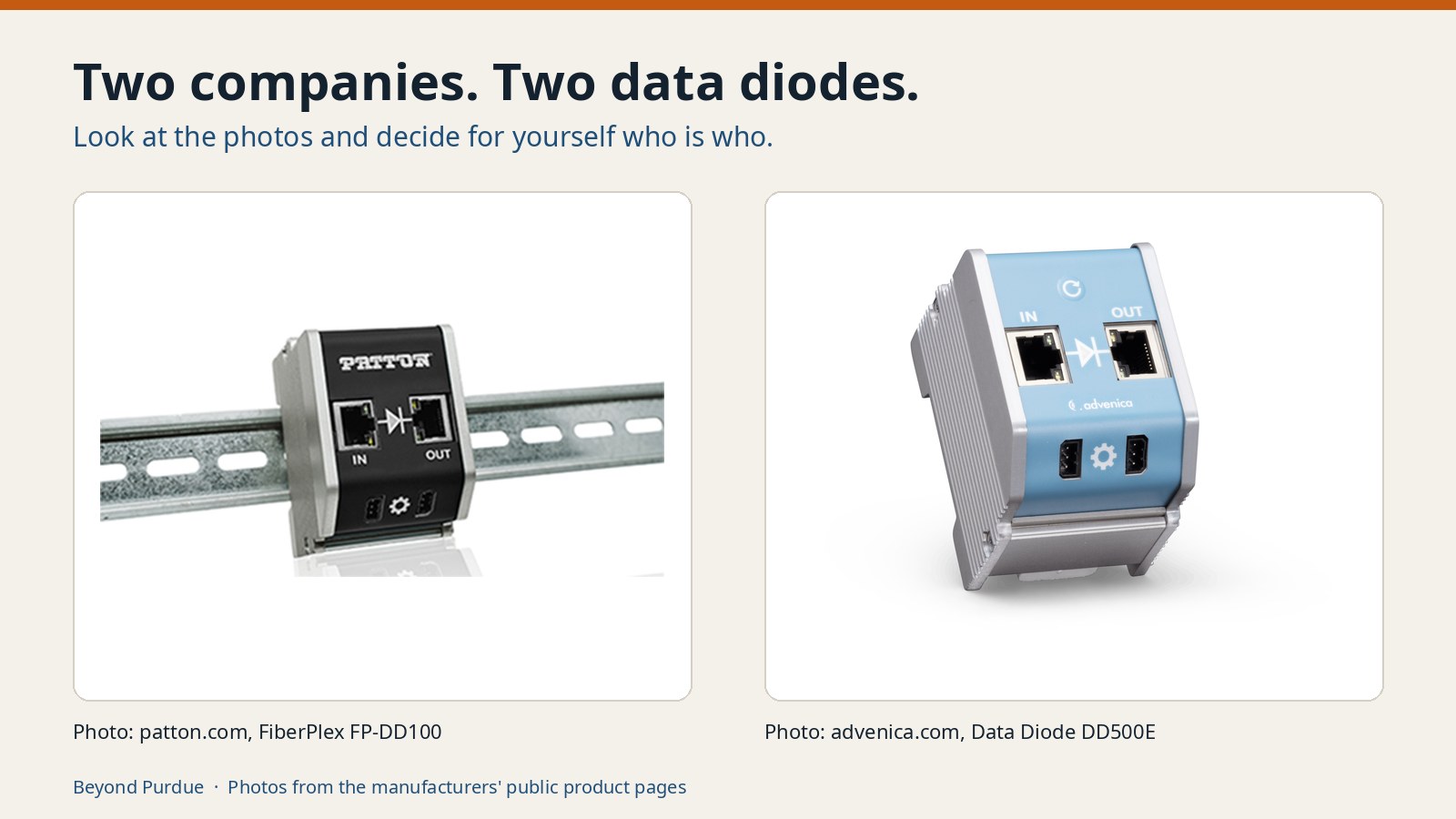
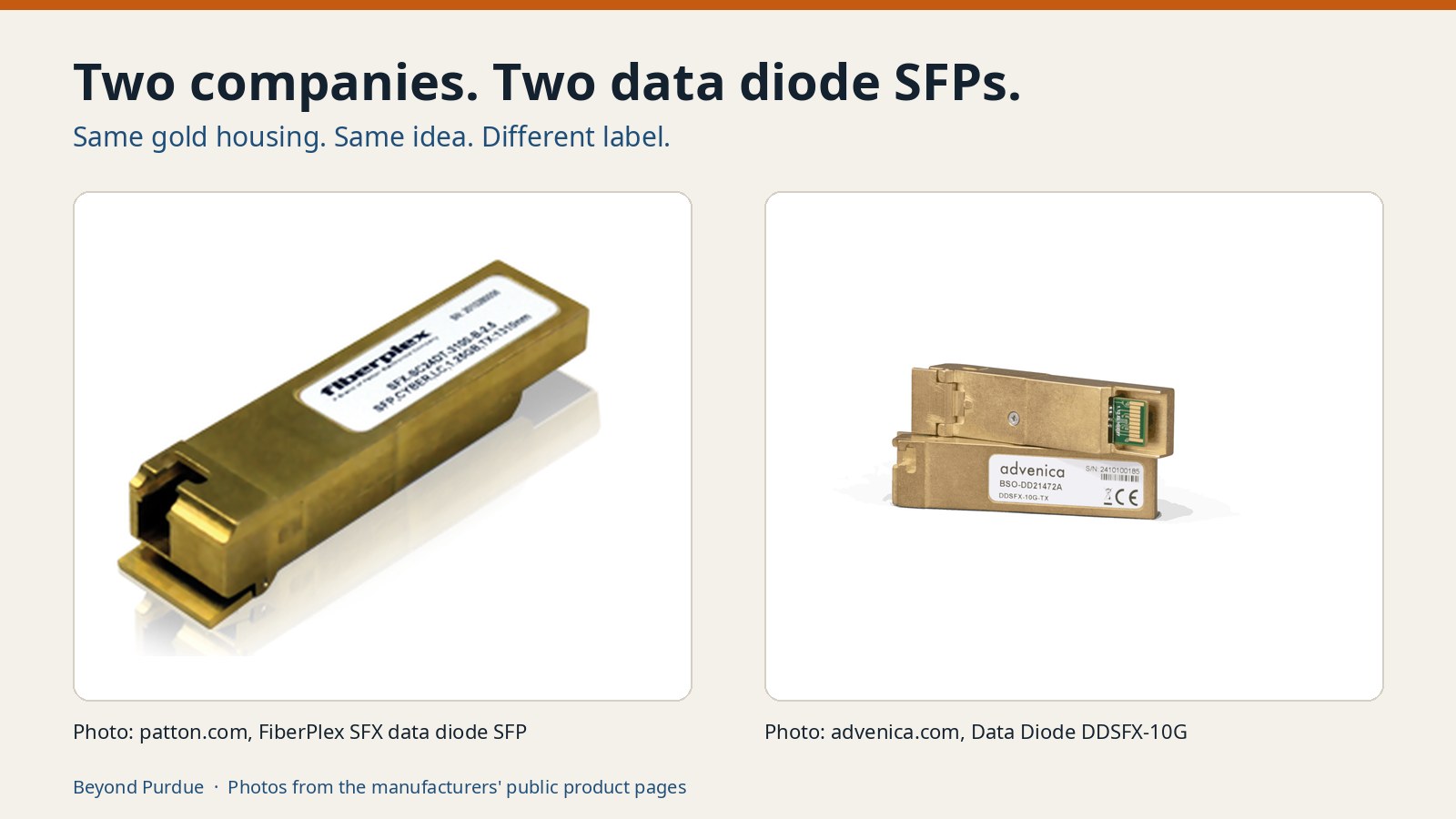
So the logo on the front tells you very little. What matters is what is inside the box.
What the standards say
NIST defines a data diode by its result: "a network appliance or device that allows data to travel only in one direction", also called a unidirectional gateway (NIST CSRC). It does not ask how the one-way rule is enforced.
The United States national security glossary goes one step closer to physics. It calls it a one-way transfer device, "usually implemented in hardware", and gives a common example: "a fiber optic isolator" (NIST CSRC, CNSSI 4009-2022). Keep that sentence in mind. We will come back to it.
Type 1: the box with software all around
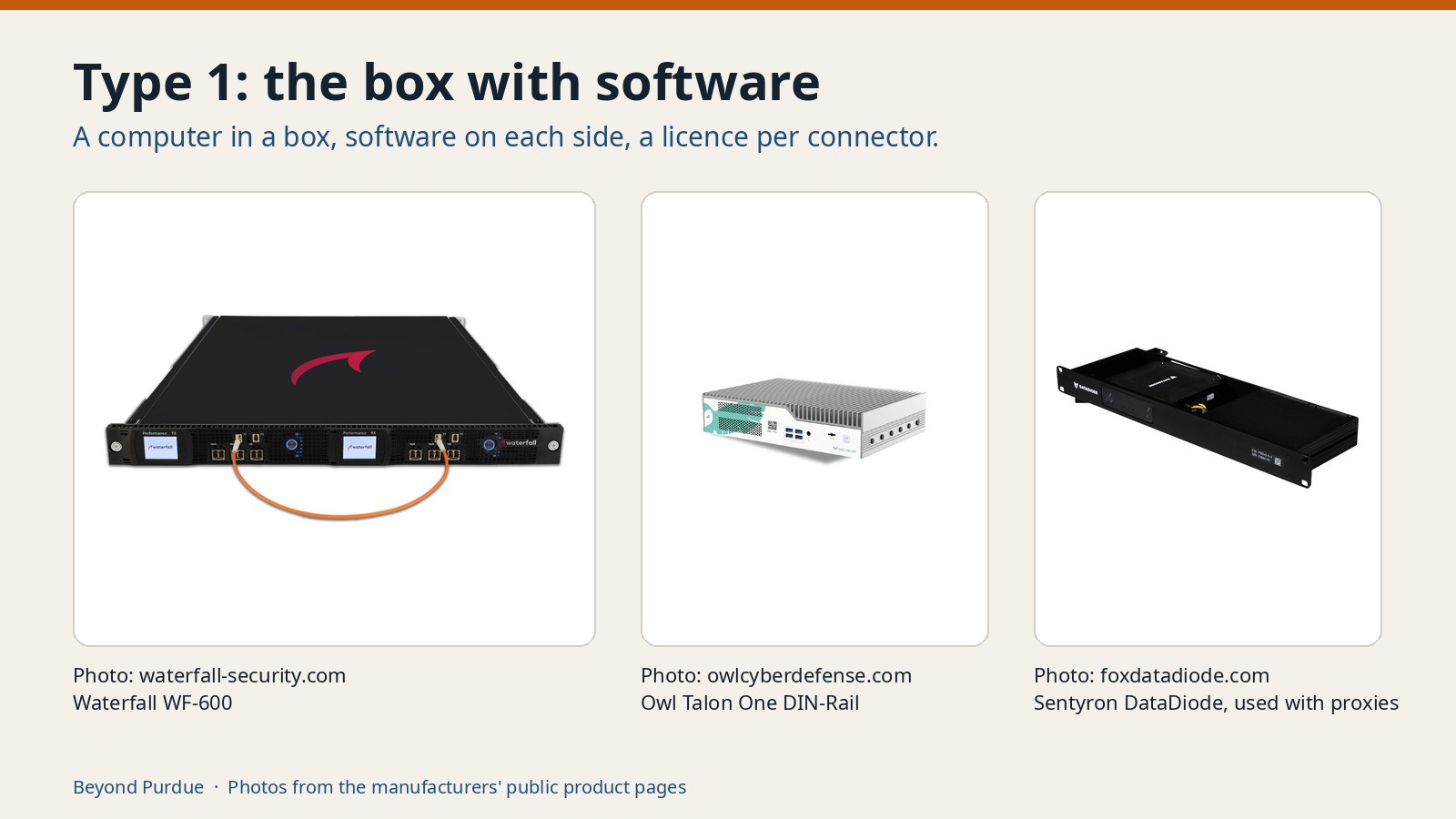
This is the biggest group by revenue. A box sits in the middle, and on each side runs a piece of software that speaks a certain protocol. The plant side collects the data, pushes it one way through the hardware, and the office side rebuilds it.
Waterfall describes its gateways as "a combination of hardware and software" with hundreds of native connectors, and its management interface is where you configure "licenses, connectors, filters" (Waterfall, Waterfall gateways). Owl says every Talon appliance is "Owl Talon software plus an NSA-approved protocol filtering diode" (Owl Talon). Sentyron requires a "Proxy Server on each side of the unit to convert bidirectional protocols into a one-way protocol" (Sentyron).
It works. But you buy a licence, you buy the connector for your system, and you depend on the vendor for both as long as the plant runs.
Type 2: the router
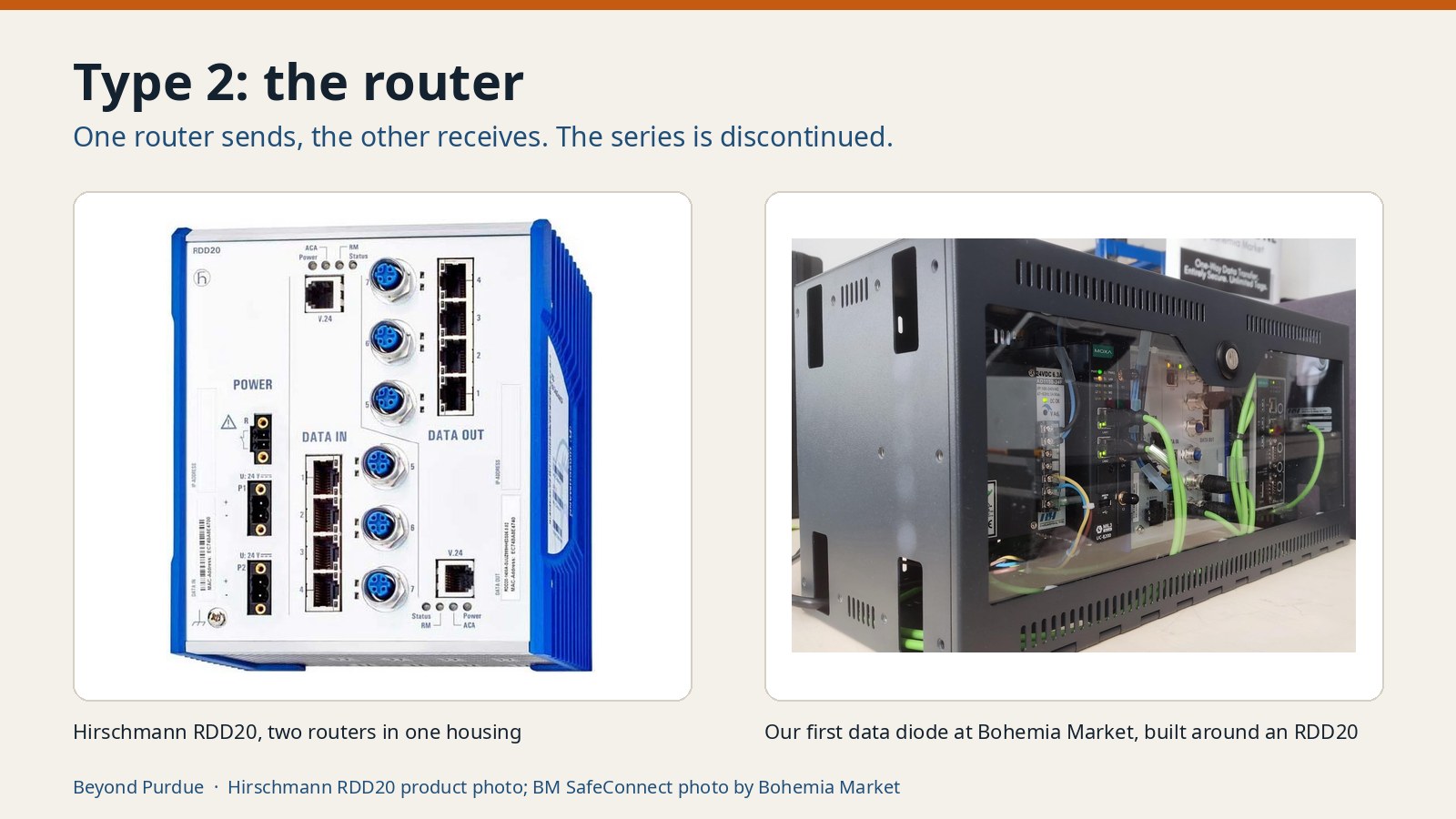
The Hirschmann Rail Data Diode RDD20 is the clearest example. Inside are "2 independent DATA IN and DATA OUT routers" with a continuous one-way connection at 100 Mbit/s between them (Belden). Each side runs its own router software that you configure.
Belden has discontinued the whole series. The last order date was 31 January 2026, the last delivery 30 April 2026, and service ends on 30 April 2031 (Belden discontinuation notice). A plant that bought one is now planning what comes next.
Type 3: the dummy device
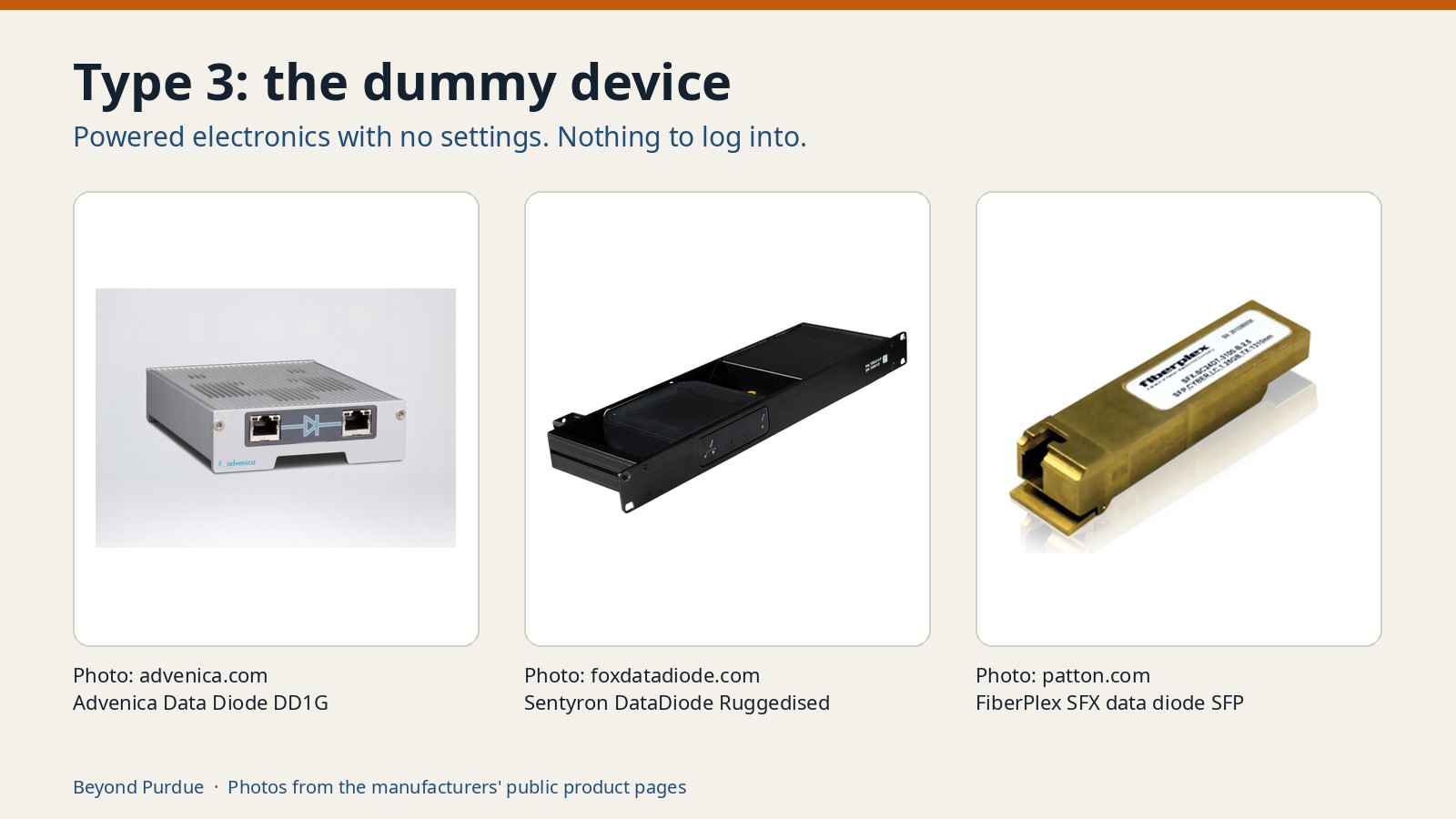
Here the box has no settings. It is electronics that passes light or signal one way, and that is all. Advenica DD1G is "a hardware only data diode" with "no configuration options", based on optical technology, with redundant 24 V power (Advenica DD1G). The Sentyron ruggedised unit is a powered 1U box with a redundant supply (Sentyron).
The smallest version is the data diode SFP. FiberPlex sells transmit-only and receive-only SFP modules with a single optical opening for one fibre, powered from 3.3 V in the host port (Patton FiberPlex SFX-1DD).
This is a big step. Nothing to log into, nothing to misconfigure. But it is still active electronics, with power, chips and a production life that ends long before the plant does.
Type 4: the passive fibre optic diode
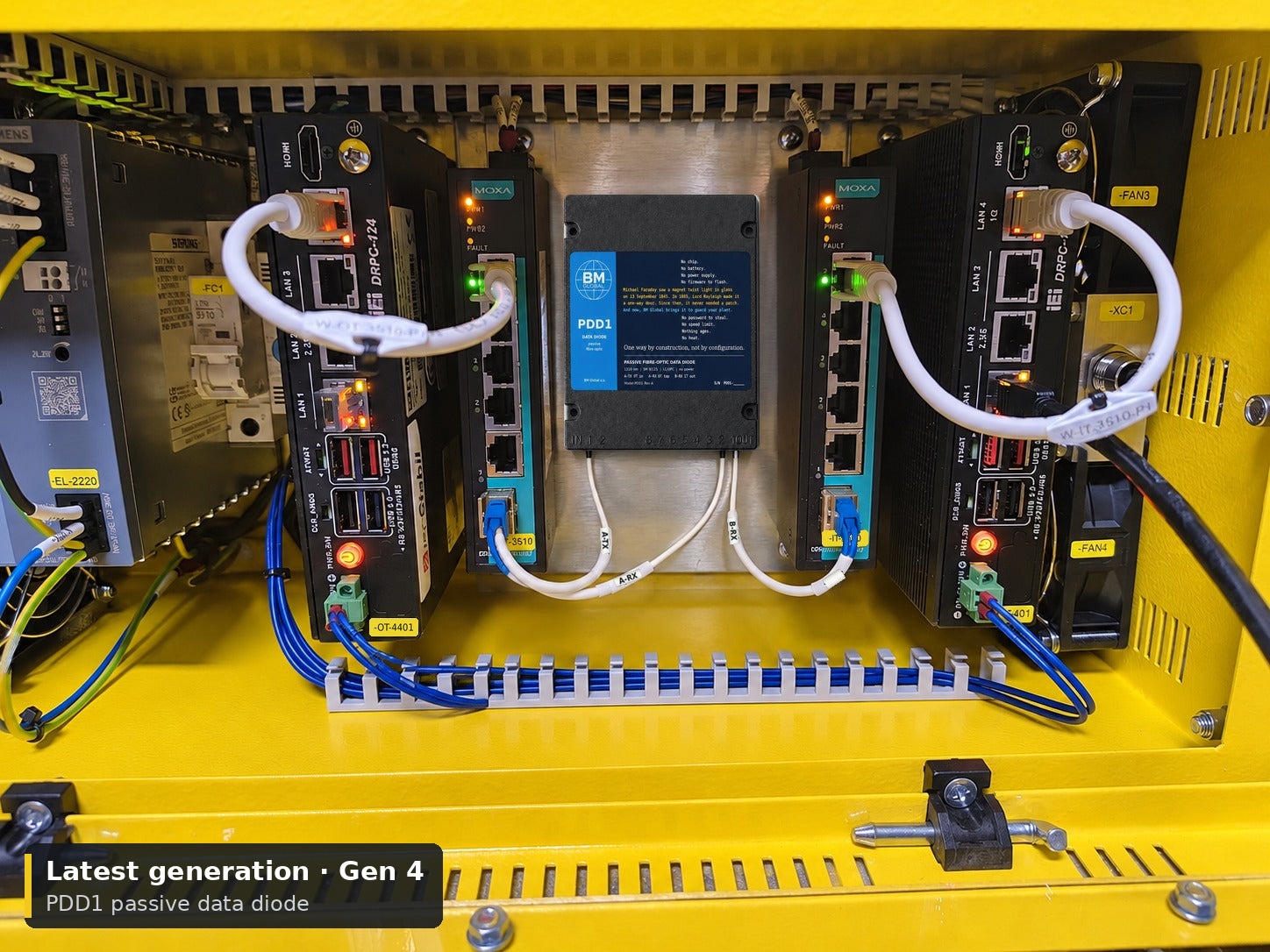
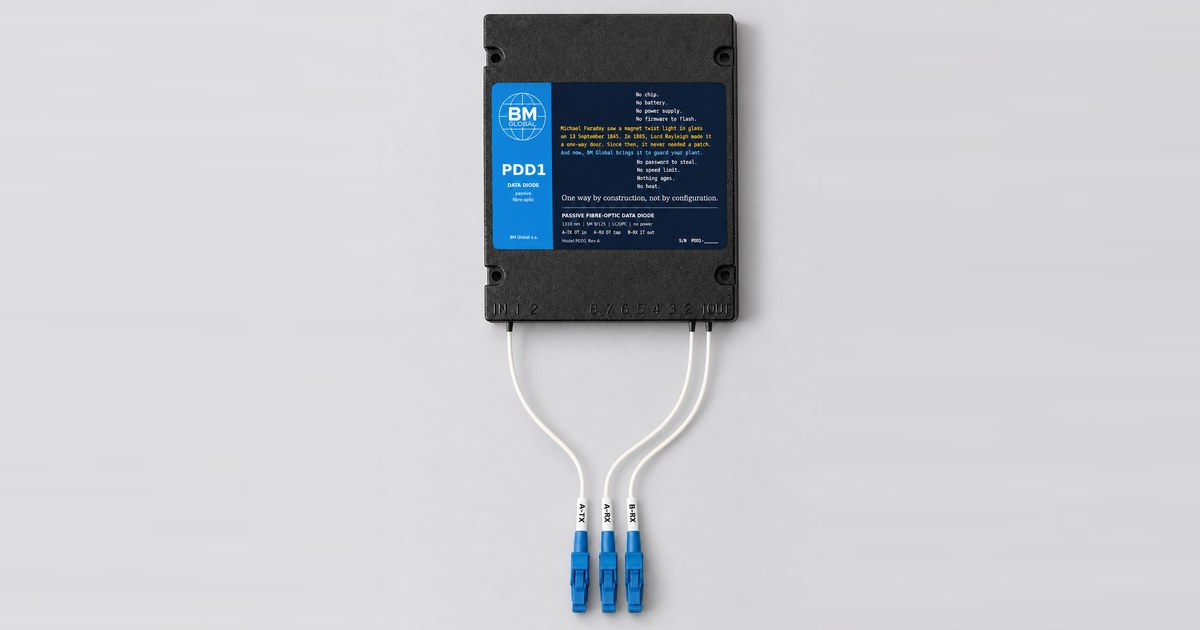
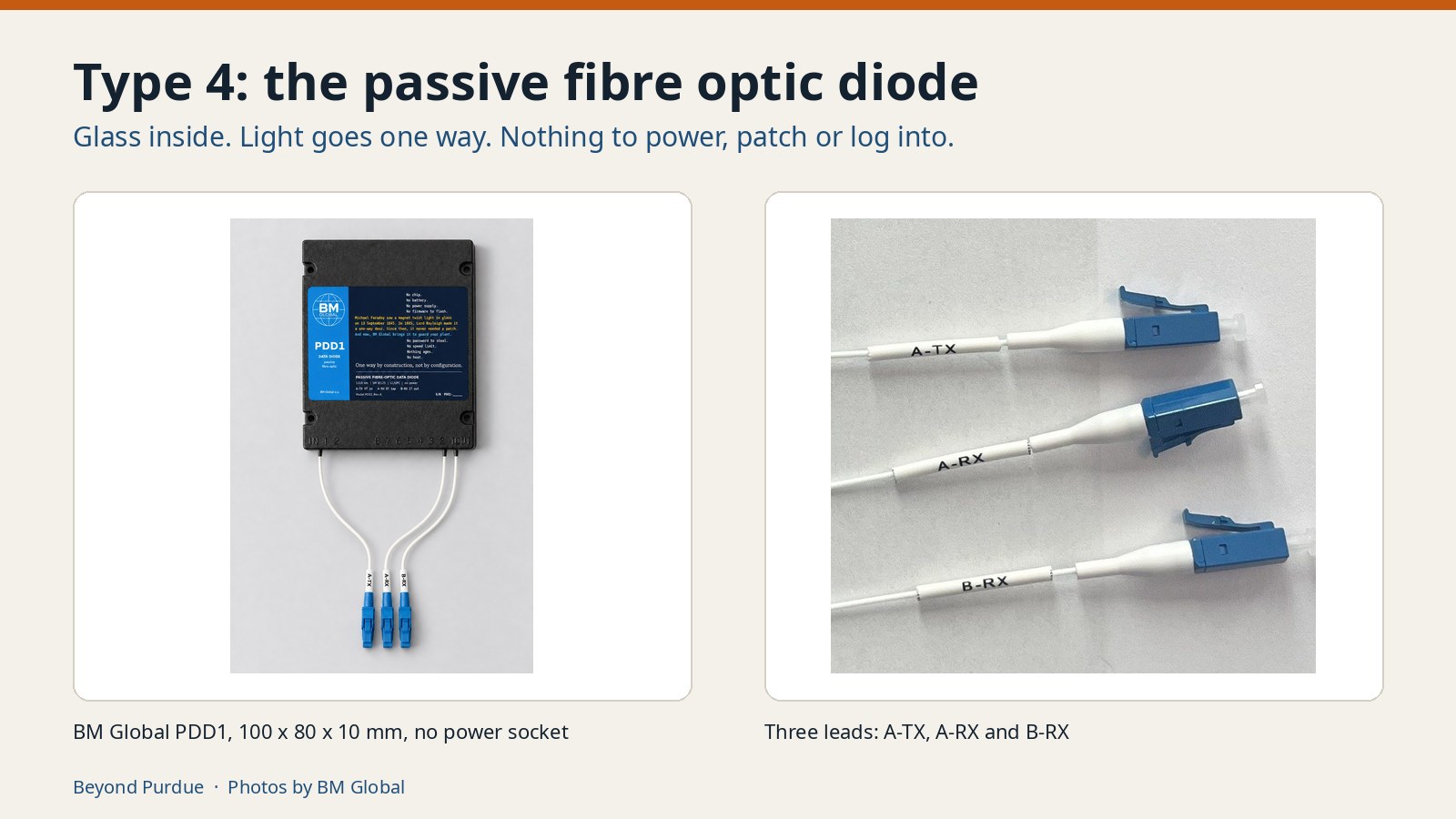
This is the latest generation, and it is where we work. There is no electronics in the path at all. A passive optical splitter and an optical isolator, sealed in a small box. No power socket, no port to log into (Beyond Purdue, The passive data diode). Light goes one way. Physics stops it coming back.
It plugs into what the plant already has. Any standard SFP port on a switch, a server, an RTU or a media converter. Nothing ages, no heat, nothing to update. This is exactly the "fiber optic isolator" that the national security glossary uses as its example of a one-way transfer device.
Our own bench test ran 175 million frames with zero lost and seven of seven files matching by SHA-256, at the 942 Mbit/s limit of the sending computer (Beyond Purdue, The passive data diode).
And the FPGA
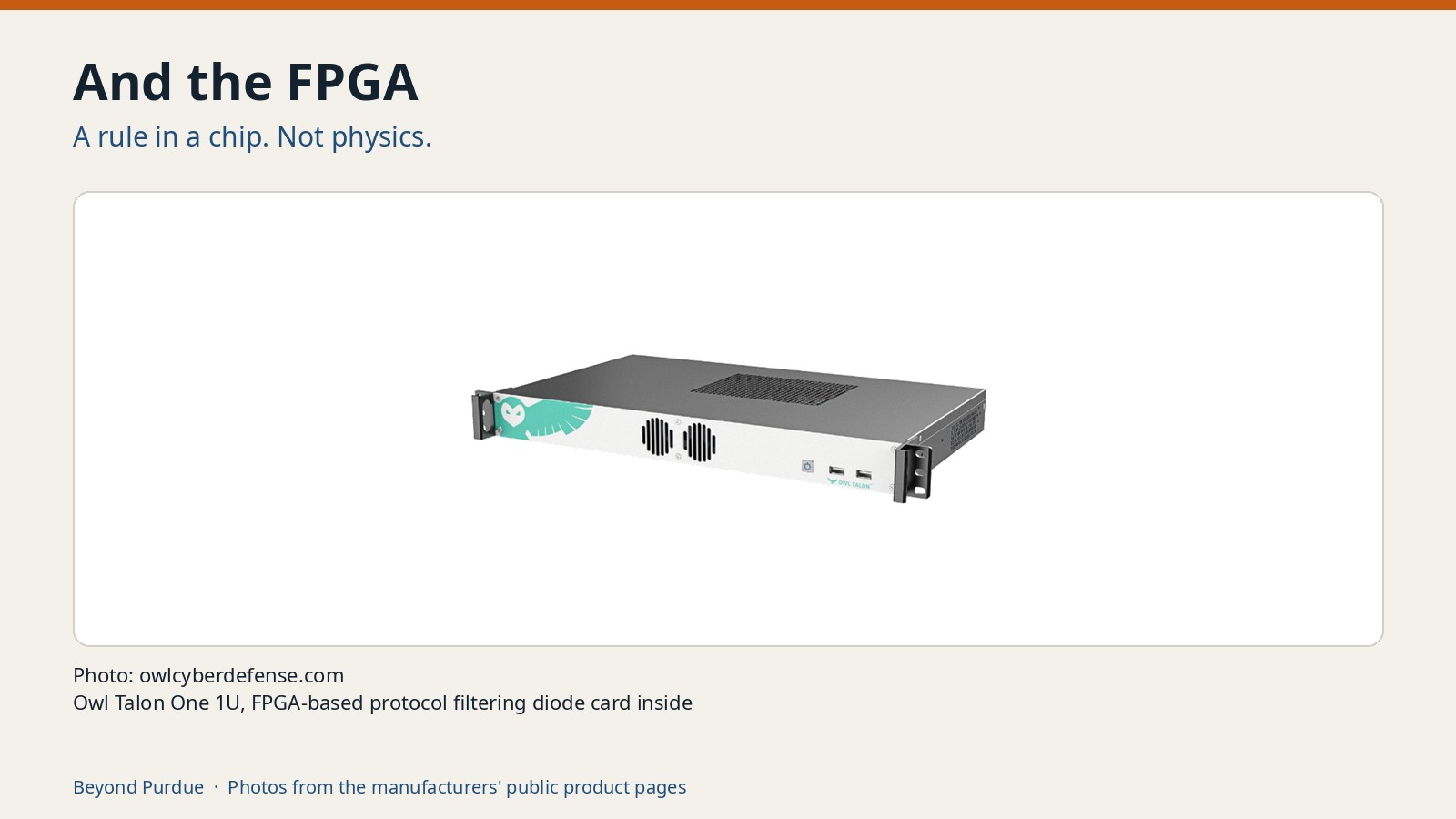
Owl's latest generation is built on FPGAs. Its protocol filtering diodes combine a hardware one-way path with "FPGA-based protocol filtering", and inside the diode "FPGAs enforce a protocol break" (Owl data diodes, Owl use case).
In my view an FPGA is not a diode. It is a chip loaded with a configuration file that nobody outside the factory can read. It is a very good filter, but a filter is a rule, and a rule can be written wrong. It is also electronics, and FPGA families go out of production long before a power plant closes. A diode is one direction by physics. If the one-way rule lives in a bitstream, it is a rule, not physics.
What each type needs on each side
- Box with software: Waterfall, Owl Talon, Sentyron with proxies. In the middle: Hardware plus vendor software. On each side: Vendor servers and connectors. Licence: Yes.
- Router: Hirschmann RDD20 (discontinued). In the middle: Two configured routers. On each side: Your network. Licence: No.
- Dummy device: Advenica DD1G, Sentyron unit, FiberPlex SFP. In the middle: Powered electronics, no settings. On each side: Your software or the vendor's proxy. Licence: Only for vendor proxy software.
- FPGA: Owl protocol filtering diodes. In the middle: Programmed logic. On each side: Vendor software. Licence: Yes.
- Passive fibre: BM Global PDD1, PDD6, PDD12. In the middle: Glass. Nothing powered. On each side: Your software. Licence: No.
Every type needs software on both sides. TCP needs acknowledgements, and acknowledgements cannot come back through a real one-way path. Even the most expensive gateway is a box with a computer on each side. The only real question is what sits in the middle.
The conclusion
If the software on each side is needed anyway, then the middle should be as simple as possible. The simplest thing that can enforce one direction is a piece of glass that does nothing.
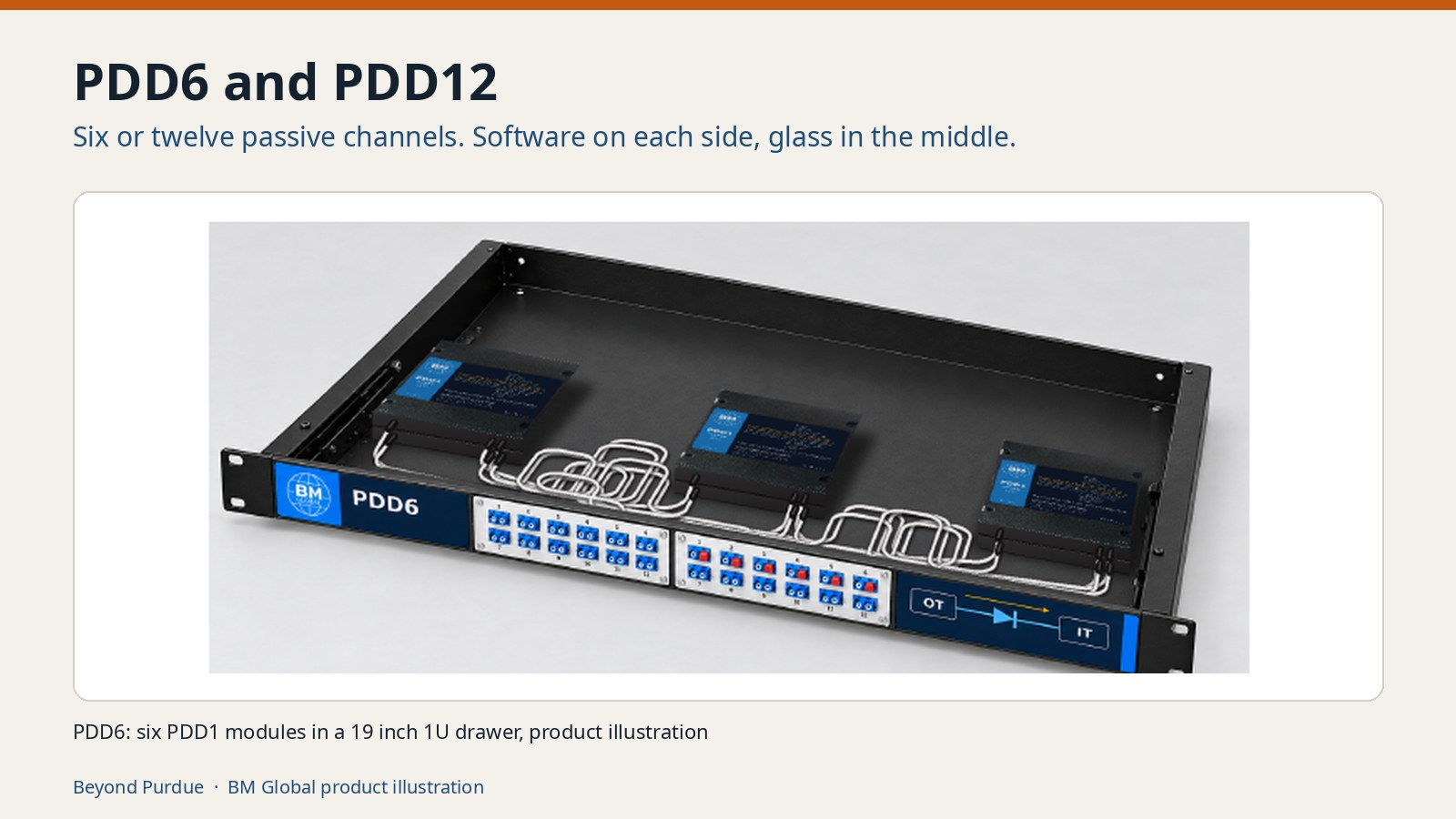
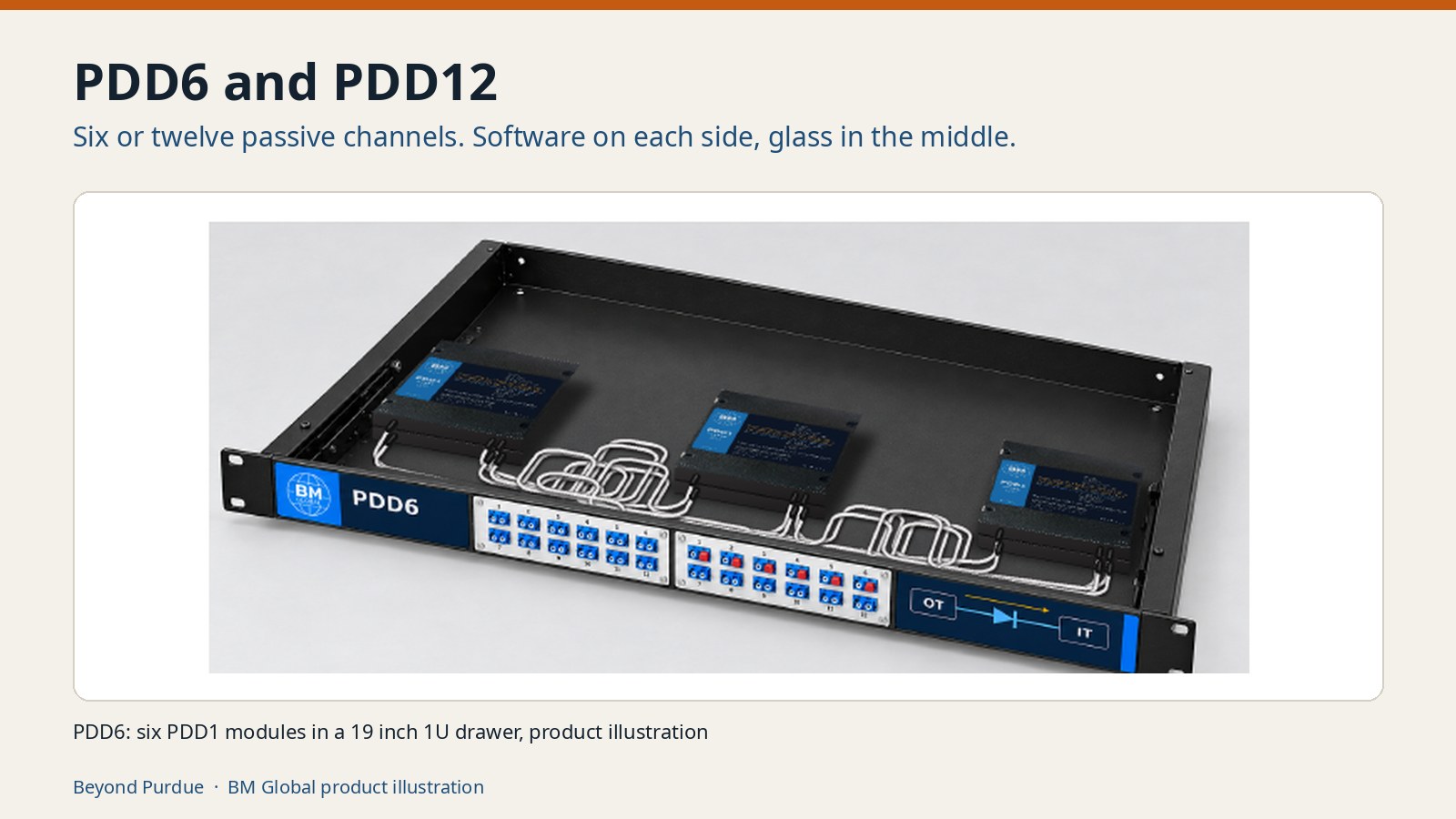
That is why we built the PDD6 and the PDD12. Six or twelve independent passive channels in one 19 inch 1U drawer. No power, no firmware, no licence, nothing to patch and nothing that goes out of production. It fits into the existing infrastructure and the existing SFP ports.
For a plant that needs data to go out and nothing to come in, nobody needs anything else.
Sources
- Wikipedia, Data diode: https://en.wikipedia.org/wiki/Data_diode
- Wikipedia, Interactive Link: https://en.wikipedia.org/wiki/Interactive_Link
- Owl Cyber Defense, About Owl: https://owlcyberdefense.com/company/about-owl/
- Owl Talon: https://owlcyberdefense.com/talon/
- Owl data diode products: https://owlcyberdefense.com/products/data-diode-products/
- Owl Protocol Filtering Diodes use case: https://owlcyberdefense.com/wp-content/uploads/2026/03/OWL_PFD_UseCase_v3.pdf
- Waterfall, company: https://waterfall-security.com/about-waterfall/company/
- Waterfall, unidirectional technology: https://waterfall-security.com/technology-and-products/unidirectional-technology/
- Waterfall, unidirectional security gateways: https://waterfall-security.com/technology-and-products/unidirectional-security-gateways/
- Buro Jansen & Janssen, Fox-IT certification history: https://www.burojansen.nl/fox-it/fox-it-in-russia-english-translation-of-an-article-from-observant-77/
- Fox-IT DataDiode factsheet (NATO repository): https://www.ia.nato.int/DocumentGenerator/repository/version/80452380-fc42-4b23-9276-523e7bef2fa3/Fox-DataDiode-EAL-7--1Gbps
- Sentyron, New name, same mission: https://foxdatadiode.com/new-name-same-mission/
- Sentyron DataDiode Ruggedised 1G-10G: https://foxdatadiode.com/solutions/sentyron-datadiode-ruggedised-1g-10g/
- Advenica turns 30 years old: https://advenica.com/advenica-turns-30-years-old/
- Advenica Data Diode DD1G: https://advenica.com/products-and-solutions/data-diodes/data-diode-dd1g/
- Advenica Data Diode DD500E: https://advenica.com/products-and-solutions/data-diodes/data-diode-dd500e/
- Advenica Data Diode DDSFX-10G: https://advenica.com/products-and-solutions/data-diodes/data-diode-ddsfx-10g/
- Patton FiberPlex FP-DD100: https://www.patton.com/fpdd100/
- OPSWAT MetaDefender Optical Diode: https://www.opswat.com/products/metadefender/optical-diode
- Belden, Rail Data Diode HV: https://www.belden.com/products/industrial-networking-cybersecurity/cybersecurity/data-diode/rail-data-diode-hv
- Belden, RDD series discontinuation notice: https://catalog.belden.com/prodimgs/AllAssets-approved/std.lang.all/l-/en/PDN-RDD-Family-2025-11-GLOBAL-EN.pdf
- Patton FiberPlex SFX-1DD: https://www.patton.com/sfx-1dd/
- NIST CSRC, Data Diode: https://csrc.nist.gov/glossary/term/Data_Diode
- NIST CSRC, one-way transfer device (CNSSI 4009-2022): https://csrc.nist.gov/glossary/term/one_way_transfer_device
- Beyond Purdue, The passive data diode: https://www.beyondpurdue.com/diode/