Beyond Purdue / Standards, OT security, AI
Who owns the rules we must follow?
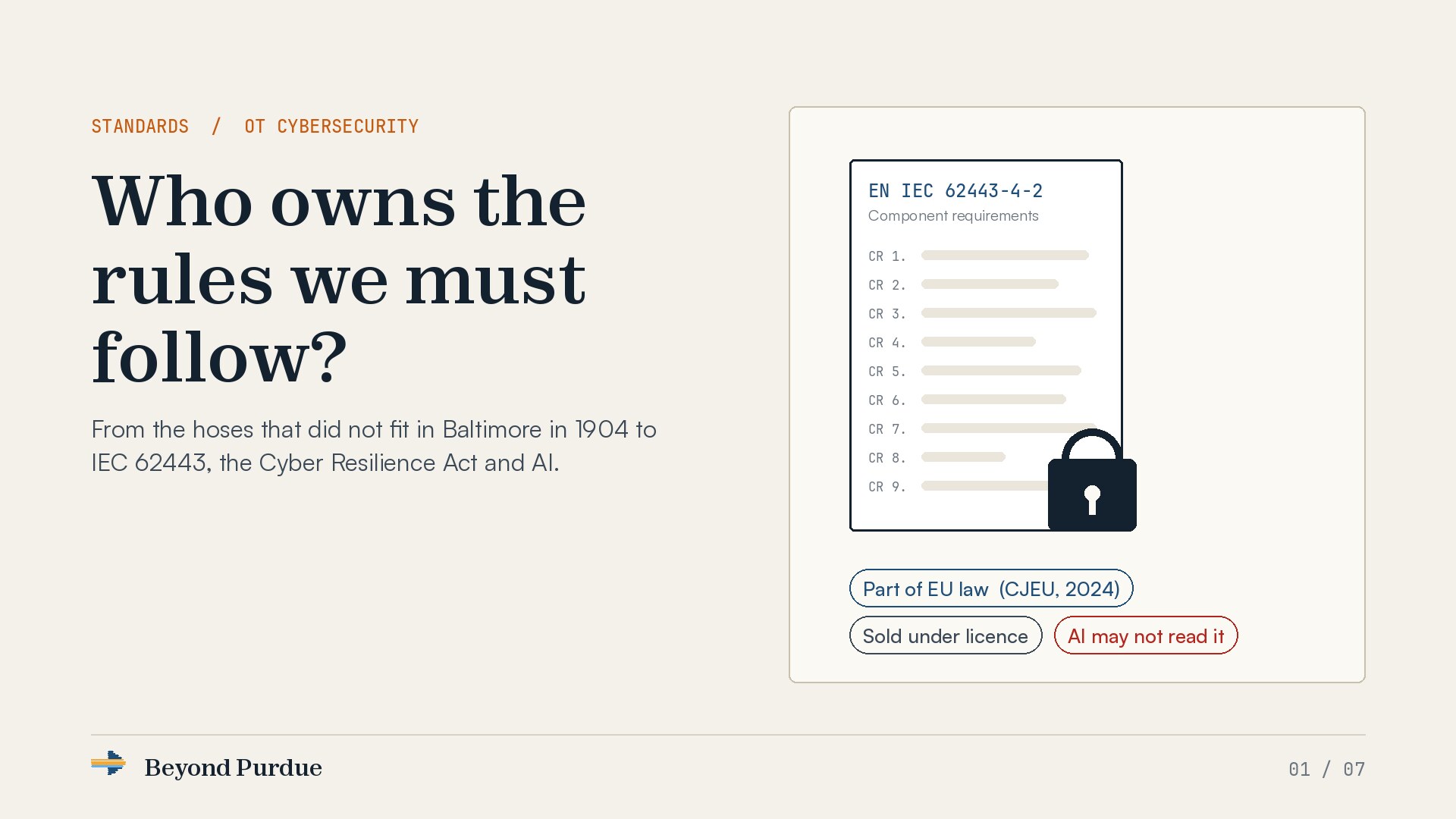
In 1904 Baltimore burned because the hoses did not fit. Today the rules that make OT products fit the law sit behind a paywall, and the licences say your AI assistant may not read them.
The hoses that did not fit
On a cold Sunday morning, 7 February 1904, a fire started in the basement of the John E. Hurst dry-goods warehouse in central Baltimore. Within minutes the building exploded. Baltimore's fire chief telegraphed Washington: "Big fire here. Must have help at once." Engine companies were loaded onto trains and were in Baltimore by early afternoon. Philadelphia and New York sent theirs too.
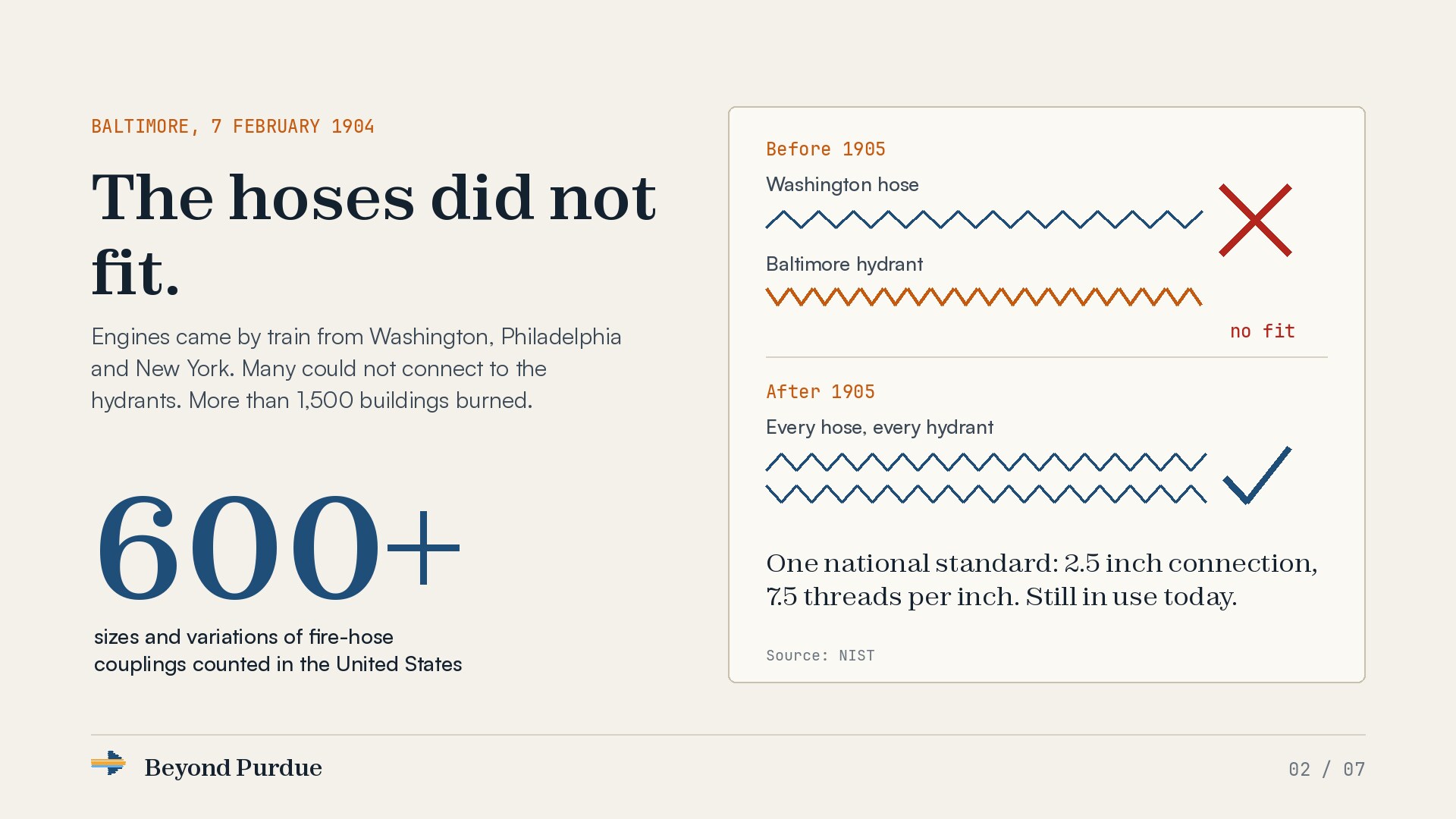
Many of them could do nothing. Their hoses would not screw onto Baltimore's hydrants. The threads were different.
The fire burned for more than 30 hours and destroyed more than 1,500 buildings (Richmond Fed). The National Bureau of Standards had already counted more than 600 sizes and variations of fire-hose couplings in the United States (NIST). Every manufacturer had its own thread, and every city bought from its own supplier.
In 1905 a committee of the National Fire Protection Association agreed one national standard: a 2.5 inch hose connection with 7.5 threads per inch. It is still the standard today (NIST).
That is what a standard is. It is a promise that things will fit together: a hose and a hydrant, a plug and a socket, a firewall and the law it must meet.
A reader asked me under my last article who should pay for that promise. This article is my answer, and it starts with how the promise is made.
Who writes a standard
A standard is written by a committee. The members are engineers from manufacturers, utilities, laboratories, universities and consultancies. Most of them are paid by their employers, not by the standards body. They meet for years, argue over every clause, and vote.
There are three levels.
- International: ISO for most subjects, IEC for anything electrical and electronic. IEC 62443, the series we use for OT security, is developed by IEC together with the ISA99 committee in the United States.
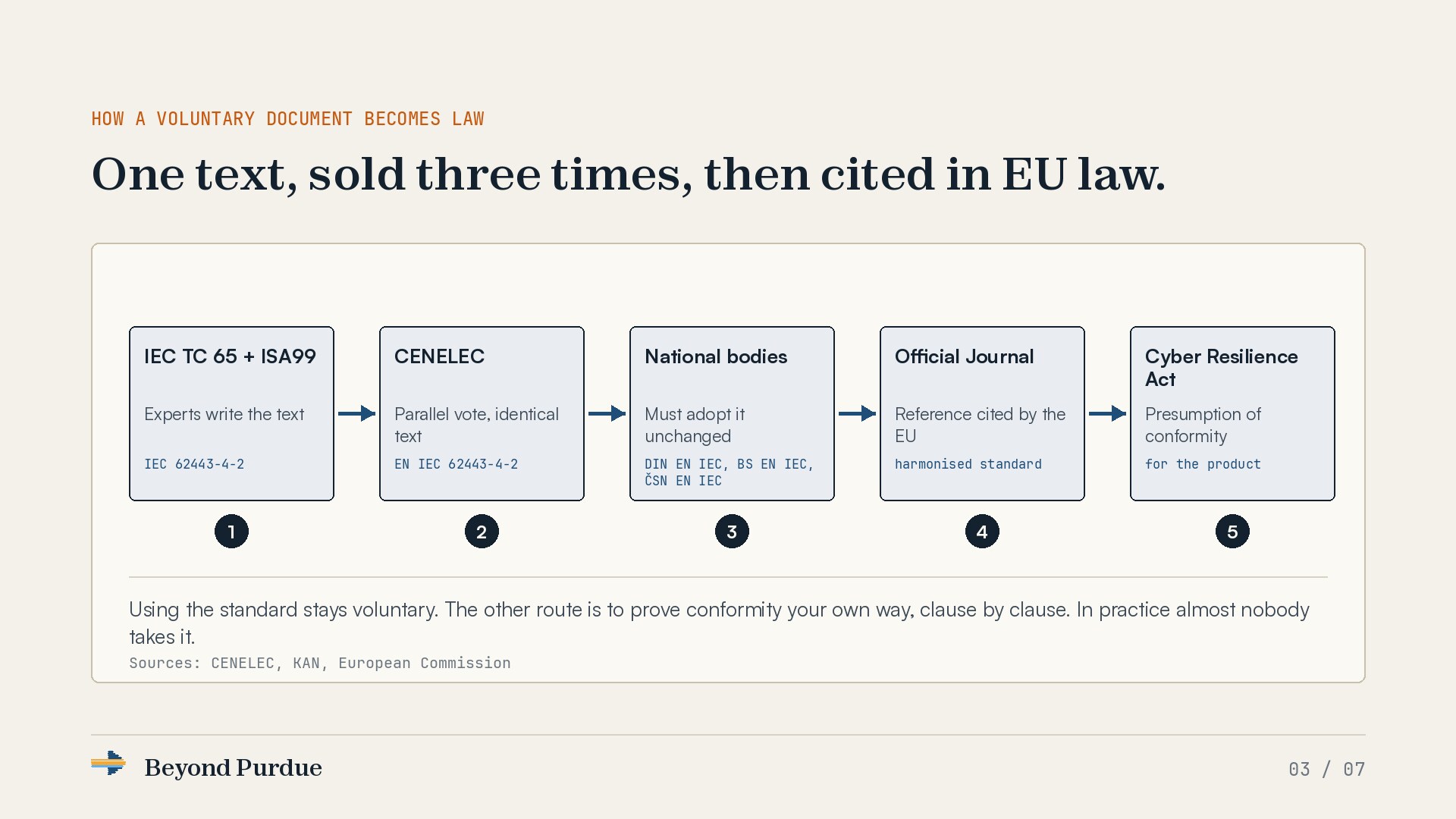
- European: CEN, CENELEC and ETSI. Under the Frankfurt Agreement, IEC and CENELEC vote on new drafts in parallel. When the text is identical, Europe publishes it as an "EN IEC" standard (CENELEC). Close to 80 % of CENELEC standards are identical to or based on IEC publications (CEN-CENELEC).
- National: DIN, BSI, AFNOR, UNMZ and the others. They must adopt every European standard unchanged and withdraw any national standard that conflicts with it (KAN).
So one text written in an IEC committee can end up on your desk as IEC 62443-4-2, EN IEC 62443-4-2 and DIN EN IEC 62443-4-2. You can buy it from three shops. The words are the same.
How a voluntary document becomes law
European product law works in two layers. The regulation sets "essential requirements" in general words. A harmonised standard explains in technical detail how to meet them. Once its reference is published in the Official Journal, a product that follows it is presumed to conform to the law.
Using the standard stays voluntary. The other route is to prove conformity your own way, clause by clause, to a market authority or a notified body. In practice almost nobody takes it.
This used to be a debate about toys and building materials. It is now ours. The Cyber Resilience Act gives a presumption of conformity to products that follow harmonised standards, and the Commission's request M/606 asks for 41 of them (European Commission). For industrial products, the vertical standards are being derived from EN IEC 62443-4-1 and EN IEC 62443-4-2 (CEN-CENELEC).
The series most of us bought one part at a time is becoming the practical route into EU law for firewalls, switches, routers, controllers and gateways.
The chemistry set case
The question of access reached the highest court in Europe through a children's chemistry set.
In 2018 two non-profit organisations, Public.Resource.Org and Right to Know, asked the European Commission for four harmonised standards. Three covered the safety of toys, including chemistry sets. The fourth was a test method for nickel released from coated items (EUR-Lex).
The Commission refused because the standards were protected by copyright. In 2021 the General Court agreed with the Commission.
On 5 March 2024 the Court of Justice, sitting as the Grand Chamber, overturned that decision in Case C-588/21 P. It held that harmonised standards "form part of EU law" because of their legal effects, and that the rule of law "requires free access to EU law for all natural or legal persons of the European Union" (EUR-Lex). The people a law protects, it said, must be able to check whether a product really meets it.
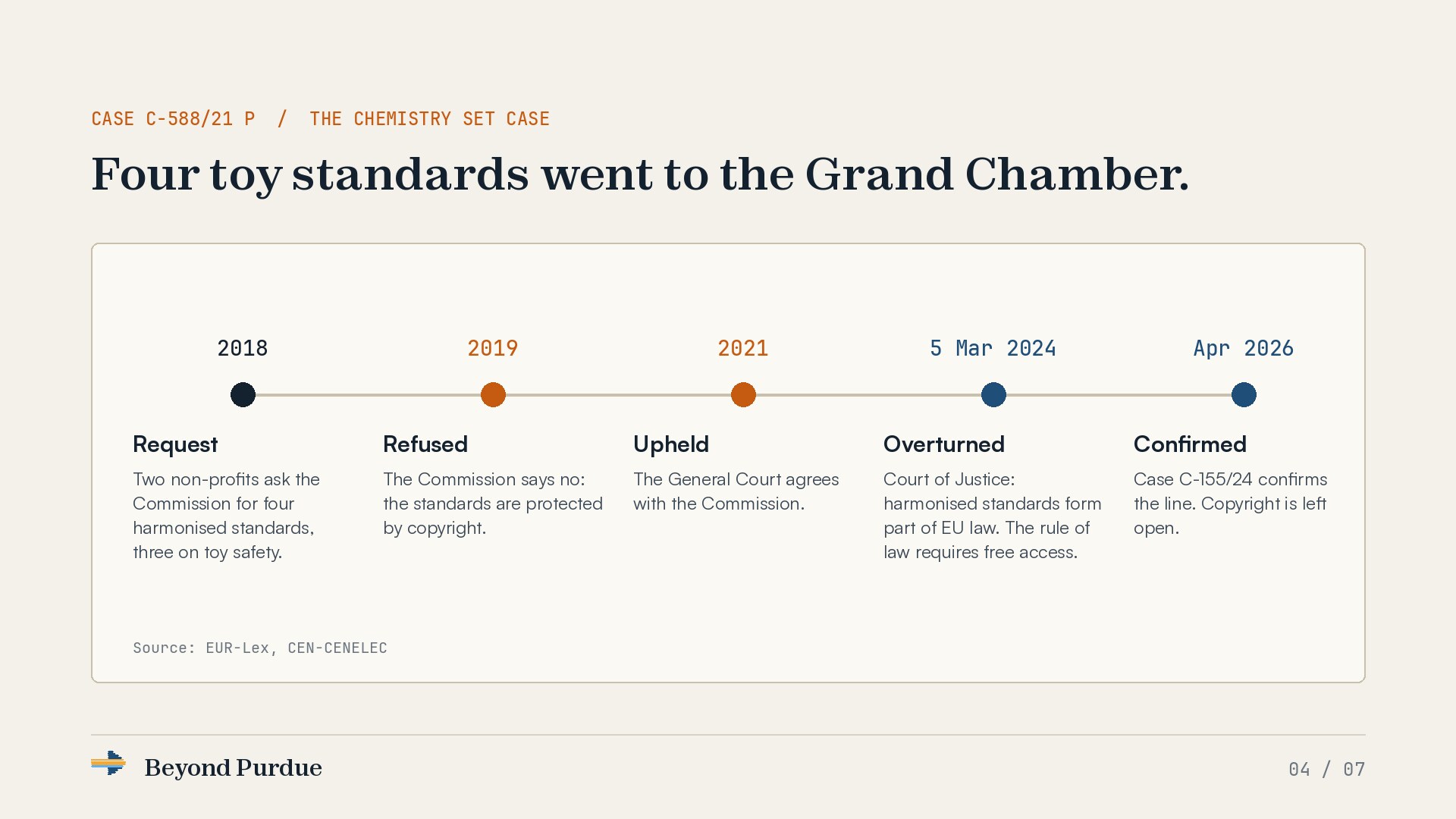
In April 2026 the Court confirmed this line in Case C-155/24. CEN and CENELEC noted that the Court again "does not pronounce itself on the existence or not of copyright" (CEN-CENELEC). In the same month a US federal appeals court ruled in ASTM International v. UpCodes that standards copied word for word into state law largely lose their copyright protection (KAN).
The law must be free. The copyright stays. For now, both at once.
What "free" looks like today
DIN now offers 446 of the 3,614 harmonised standards free of charge. Free means you can read them online. You cannot download or print them without a paid licence (KAN).
ISA gives its members free viewing of most ISA standards, but not of those that are identical IEC adoptions (ISA). Several parts of 62443 are exactly that.
Reading a clause on a screen is not working with it. On a real project I compare editions, map each requirement to my zones and conduits, and show the auditor where it is met. A Baltimore firefighter needed the thread count in his hands, not behind glass.
Then AI arrived
This is the part my reader asked about, and it is the part that surprised me most.
The IEC webstore terms say buyers shall not use IEC products "in any manner in AI technologies whether publicly available AI tools or privately licensed AI tools" without IEC's express permission (IEC Webstore).
ISA's notice on its 62443 page prohibits entering any ISA standard "into any form of Artificial Intelligence (AI) tools", and warns that ISA will suspend access and consider legal action (ISA).
ISO's licence forbids processing an ISO publication for "any machine learning, artificial intelligence (AI), or analogous computational purposes" without a separate licence (ISO). DIN's FAQ answers the question "May I use standards for AI applications?" with one word: "No" (DIN).
So I buy the standard. The law expects me to follow it. And my assistant may not read it.
Two risks that are not the same
I do not dismiss the concern. AI can invent clauses, mix up editions and sound convincing while being wrong. In a power plant that is not a style problem. It is a safety problem.
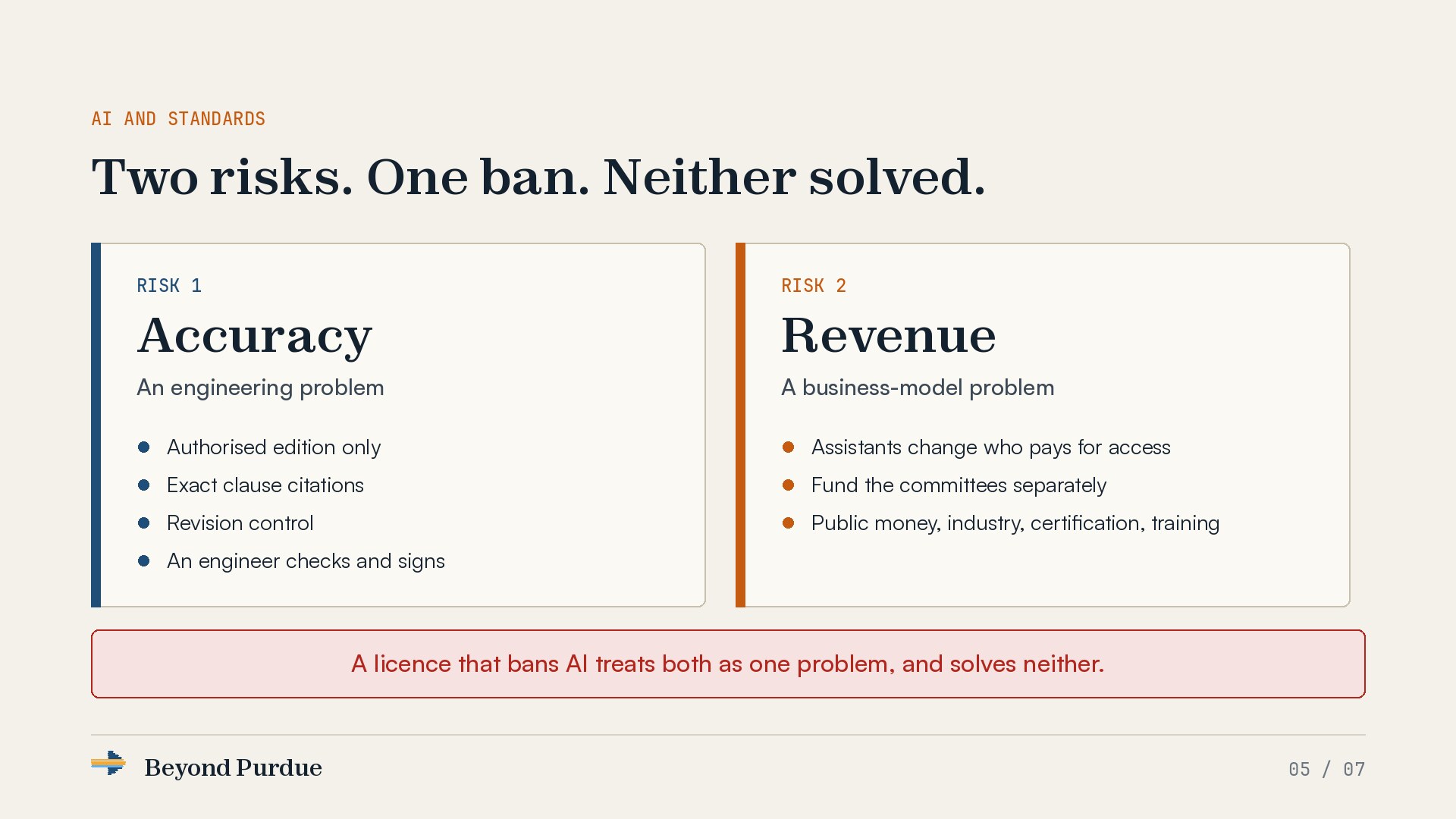
But two different risks are hiding under one word.
The first is accuracy. It needs engineering safeguards: the authorised edition, exact clause citations, revision control, and an engineer who checks and signs. We already demand exactly this from a human consultant.
The second is revenue. An assistant that helps thousands of engineers understand requirements changes the economics of selling access to those requirements.
The first is an engineering problem. The second is a business-model problem. A licence that bans AI treats them as one, and solves neither.
How we work with it today
At BM Global we buy our standards per seat and keep them on a staff-only shelf. Client documents cite clause numbers and never carry the licensed text.
That is the honest way to work under the current rules. It is also slow, and it has a cost nobody counts. The asset owner who cannot afford the full series ends up relying on the vendor's reading of it. The party that supplies the system also interprets the rule it must meet. I wrote about this in When the Supplier Marks Its Own Cybersecurity Homework. In conformity assessment we would not accept it. In access to standards we accept it every day.
Who should pay
The committee work is real and it costs money. ISO reported 49.3 million Swiss francs of revenue for 2025. Of that, 22.3 million came from membership fees, 14.8 million from royalties on standards its members sell and 7.6 million from its own sales (ISO annual report 2025).
But funding the work and charging for access are two separate decisions, and other models already exist. Slovenia moved part of the funding of its standards institute SIST to the state budget, so its harmonised standards are free to the public. BSI, AFNOR and AENOR earn mainly from certification, test marks and training. DIN is testing sponsored access, where a ministry or an industry association pays instead of the end user (KAN).
The Commission is moving too. Its impact assessment for the new standardisation regulation says "the obligation to provide free and unrestricted access to referenced standards is necessary" (European Commission).
What I propose
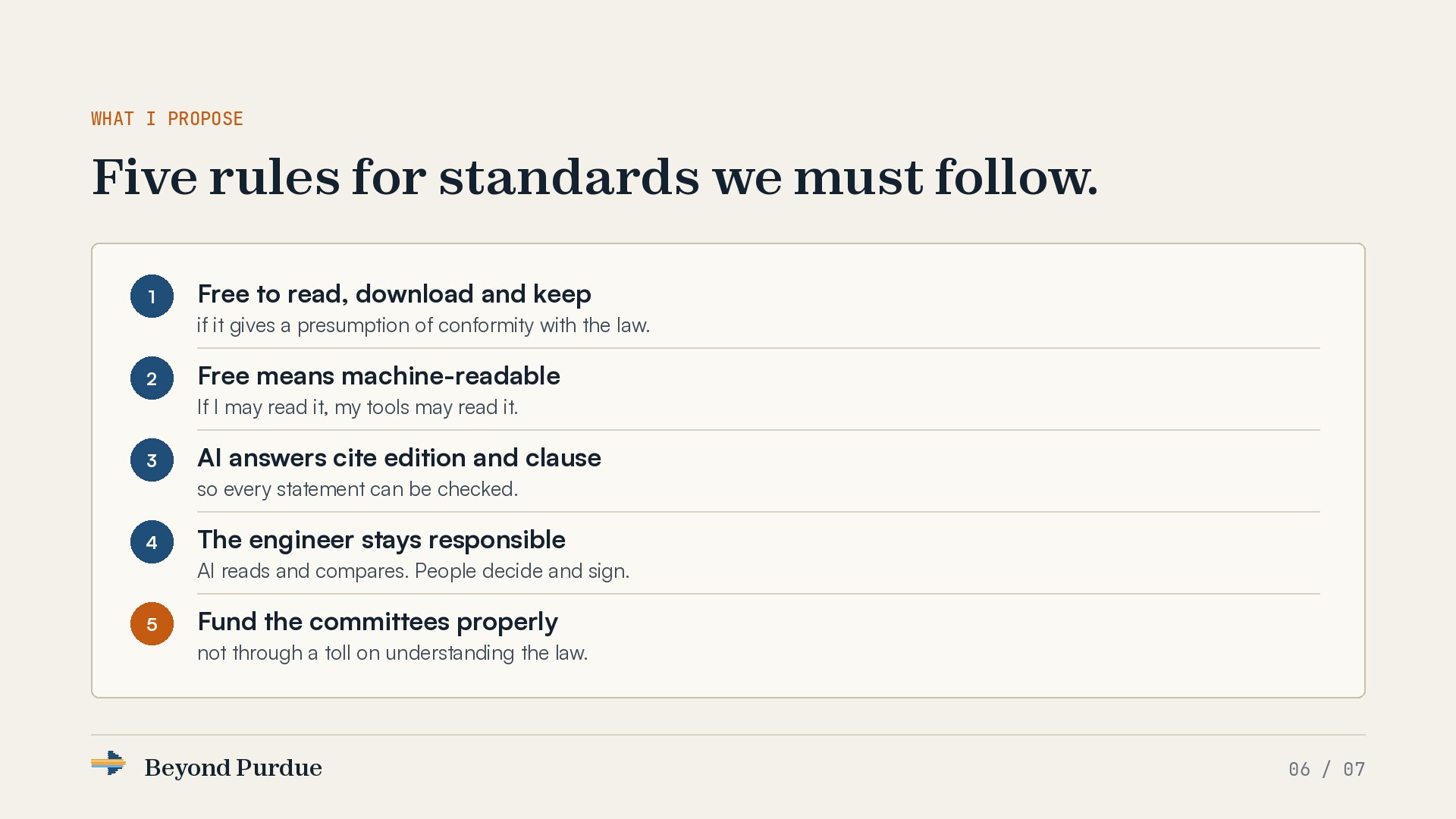
Five simple rules, from someone who has to apply these documents in real plants:
- A standard that gives a presumption of conformity with the law is free to read, download and keep.
- Free means machine-readable. If I may read it, my tools may read it.
- AI answers about standards cite the authorised edition and clause, so every statement can be checked.
- The engineer stays responsible. AI reads and compares. People decide and sign.
- Committees are funded properly, through public money, industry participation, certification, training and software, not through a toll on understanding the law.
This is not a proposal to stop paying experts. It is a proposal to stop confusing the price of a PDF with the value of the engineering behind it.
Back to Baltimore
The 1905 thread count worked because every fire company could learn it, gauge it and cut it. A standard nobody can read is like a hydrant behind a locked fence. It may be the right size, but it does not help when the fire starts.
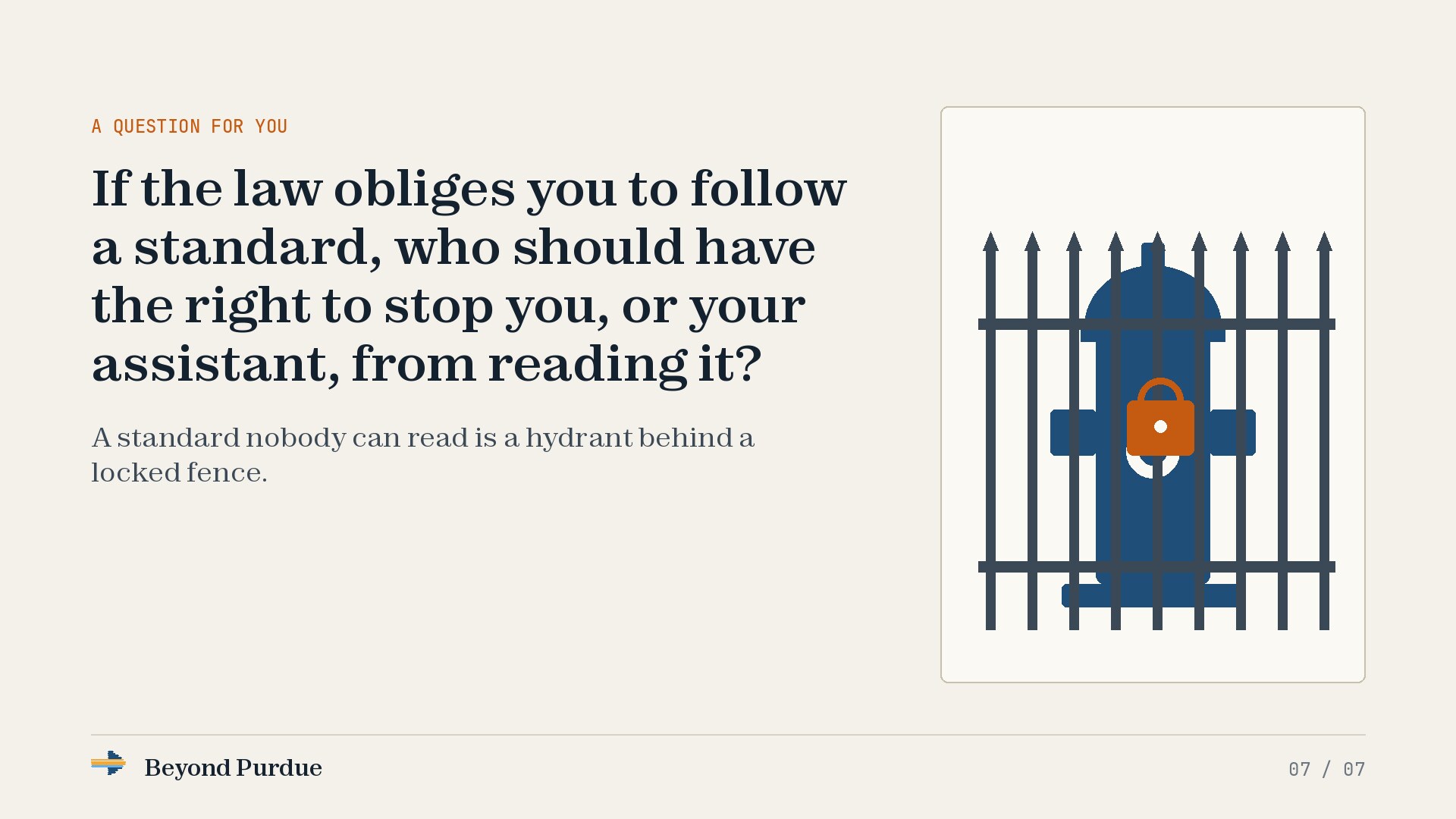
If the law obliges you to follow a standard, who should have the right to stop you, or your assistant, from reading it?
Petr Roupec, Managing Director of BM Global
Sources
- Federal Reserve Bank of Richmond, Conflagration in Baltimore
- NIST, The Founding: Overview
- NIST, Major U.S. Cities Using National Standard Fire Hydrants, One Century After the Great Baltimore Fire (NISTIR 7158)
- CENELEC, European Standards (EN IEC) under the Frankfurt Agreement
- CEN-CENELEC, CENELEC and IEC cooperation
- KAN, Cooperation between the international and European standards organizations, KANBrief 2/24
- European Commission, Cyber Resilience Act standardisation
- CEN-CENELEC webinar, From EN IEC 62443 to CRA
- EUR-Lex, summary of Case C-588/21 P
- Court of Justice of the EU, Case C-588/21 P, Public.Resource.Org and Right to Know v Commission, 5 March 2024
- CEN-CENELEC on the Court of Justice judgment in Case C-155/24, April 2026
- KAN, The end of the paywall for standards?, KANBrief 2/26
- ISA, ISA/IEC 62443 series of standards and Artificial Intelligence Notice
- IEC Webstore, terms and conditions
- ISO, licence agreement
- DIN, reproduction FAQ
- ISO, annual report 2025
- European Commission, COM(2026) 780 and impact assessment
- Beyond Purdue, When the Supplier Marks Its Own Cybersecurity Homework